Showing posts with label drugsploitation. Show all posts

Tuesday, July 6, 2010

Sunday 4th July 2010: Dwain Esper triple!

How To Undress In Front Of Your Husband

USA 1937 b&w

aka How To Undress

Director/Writer Dwain Esper

Cast Elaine Barrie Barrymore (herself), Trixie Friganza (Trixie), Hal Richardson (Peeping Tom), Albert Van Antwerp (Narrator)


Sinister Menace

USA 1930 b&w

aka Sinister Harvest

“Presenter”/Writer Dwain Esper


Narcotic

USA 1933 b&w

aka Narcotic Racket

Directors Dwain Esper, [uncredited] Vival Sodar't Writers A.J. Karnopp, Hildegarde Stadie

Cast Harry Cording (Dr. William G. Davis), Joan Dix (Mrs. Davies), Patricia Farley (Mae), Jean Lacey (Lena)


Tonight we revisit an old friend of Schlock Treatment's, the carnival huckster Dwain Esper, whose sleazy roadshow anti-classics – Marijuana The Weed With Roots In Hell, Maniac, The Strange Love Life Of Adolph Hitler, to name a few - were the filmic equivalent of Snake Oil. Esper's films, both as director and distributor, were of the salacious kind, lurid exposes on the darker impulses of his prim yet prurient audiences masquerading as morality plays. Vice, madness, addiction and damnation were all four-walled across Depression-era America by Esper's one-man caravan, and he made a tidy profit throughout the Thirties and into the Forties as an independent filmmaker SO independent, he could be described as outstanding in a field of one.


Tonight's feature is augmented with two of Esper's shorter subjects. How To Undress In Front Of Your Husband from 1937 is a bizarre creature, a burlesque short of pure vaudevillian cheesecake cloaked as a manual for “relief of marital boredom”. In true exploitation style, Esper secured the services of silent star John Barrymore's then-wife Elaine Barry, a scandal on legs who was only too happy to expose said legs (and the rest!) while cashing in on her fifteen minutes of infamy. Esper cuts from Barrie's masterful disrobing – the artistry! The aesthetics! The SUSPENSE! - with the lumbering boudoir ritual of stage comedienne Trixie Friganza, whose elephantine gracelessness prompts our Peeping Tom narrator to heap scorn upon scorn into lines such as “Life is a bowl of cherries for Trixie, and she's the pits!” Leering, snide and hateful, it's nevertheless a thrill-ride for stocking sniffers and foot fetishists of all ages.


The second short takes the word “hateful” to another plateau. An early example of a Mondo Cane-style shockumentary, Sinister Menace from 1930, purports to be Egyptian government footage of the narcotics trade, with a new foaming-at-the-mouth tirade on the evils of drugs that's 100 percent pure vintage Esper. Tales abound of hash smuggled into Egypt on the backs of camels, and of evil pushers lacing their dope with crushed human skulls. These are NOT actors, the film reminds us, “just fellow human beings”, and thus starts the camera's journey along the trail of human wreckage captured, no doubt, by an Egyptian Esper clone. Haggard, haunted faces in hideous closeup, shaking and crawling with flies, are reminiscent of images from Nazi propaganda films such as The Eternal Jew, and as America's War on Drugs was just starting to warm up in the early Thirties, Esper's own propaganda is a similarly cruel and inhuman piece that would warm the cockles of Joseph Goebels' ice-cold heart.


And so to our feature tonight, which proves once and for all that Dwain Esper was the Ed Wood Jr of his generation of roadshow pioneers, and that Narcotic from 1933 is the Glen Or Glenda of the Drugsploitation genre. A bold claim, I hear one or two of you declare, but just wait for Narcotic to unfold. On the surface it's the confessions of one Dr William G. Davis, promising doctor with his own Free Clinic, loving wife, and a caring friend in his former classmate Mr Wu (played with squinted reverence by Caucasian actor and Esper's assistant on Maniac, J. Stuart Blackton Jr!). Wu introduces Davis in garbled Confucian to one of Chinatown's many opium dens and to the pipe's dangerous charms, but warns him that any defect in character will allow the drug to take hold. Before the smoke clears Davis has his own home opium den, is selling tiger fat on street corners as the miracle ointment Wang Fang, and cavorting with socialites and underwear-clad showgirls in a recreation of a dope party which eclipses any scene from Reefer Madness. Davis produces a veritable all-you-can-ingest pharmacopia, from “C” to “H”, snorting AND main-lining (says one girl, “It takes a needle for me to get a bang!”) and some jazz cigarettes for an extra ding or ping or pop, or whatever Harlem lingo was hip that season.
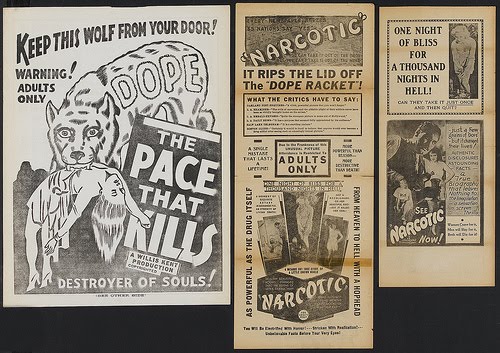

Sadly for Davis he's just one of a million addicts, claims Esper, in the US at the time, and discovers only too late the old adage “you can take it out of the body, but not out of the mind”. For Davis there is only one way out, he writes in a letter addressed to Dwain in the opening credits, a self-reflexive moment very much like Ed Wood's own confessional Glen Or Glenda, and from a filmmaker whose career has more than a passing resemblance to that of Davis' snake oil salesman. And, like Glen Or Glenda, Narcotic is an eccentric patchwork of a film, stitched together from silent car chases, footage of circus freaks, the birth of a baby and rattlesnakes in the wild, and probably the same shots of lightning bolts that Ed Baby used as punctuation. It's an astounding work by one of the Thirties most idiosyncratic filmmakers, and only goes to prove that those Thirties roadshow pioneers were exploitation alchemists – adding a tincture of sin here, a pinch of derriere there – posing as Victorian-era moralists. Dwain Esper, you're not fooling anybody, as we reveal the horrors of Z-grade Drugsploitation in the 1933 Narcotic.

Saturday, April 26, 2008

16th May 2008: There Never Were Any "Good Old Days" triple!

Maniac


USA 1934 b&w

aka Sex Maniac

Director Dwain Esper Writer Hildegarde Stadie

Cast Bill Woods (Don Maxwell), Horace B. Carpenter (Dr Meirschultz), Ted Edwards (Buckley), Phyllis Diller - no, not THE Phyllis Diller (Mrs Buckley)


Tonight we travel back to the Thirties to discover what truly characterized that decade: SEX! VIOLENCE! DISEASE! INSANITY! All of which proves, there never were any "good old days".


Tonight's two films are from Dwain Esper, a writer, director, producer and exploitation showman extraordinaire. He didn't just live on Poverty Row, he lived on its outer fringes, and still managed to survive for over twenty years as one of the most independent of all indies. His lurid filmography reads like a roll call of wrongness: How To Undress In Front Of Your Husband, The Strange Love Life Of Adolph Hitler, and Marijuana The Weed With Roots In Hell. For a while he was also owner of the 1932 film Freaks which he retitled Nature's Mistakes, and toured it with an actual freakshow in the lobby. Like any showman worth his salt, he took the most sensationalist of topics, turned them into a carnival, and charged an arm and a leg for something not even worth a finger. Now THAT's exploitation!


“Isn't the spark that moves the maggot the self-same spark that moves the man?” Thus poses Esper's best known film Maniac from 1934, an attempt at making a horror film disguised as a social statement whilst failing miserably at both, and yet making something completely new in the dialectic process. It's the tale of crazed Professor Meyerson, a woolly haired, panda-eyed scientist doing a risible Bela Lugosi impression, and his assistant, a second-rate vaudeville actor named Maxwell who does his best despite Meyerson's constant criticisms ("Vonce a ham, alvays a ham!"). Neighbours have been noticing the pair's ghoulish experiments in reviving dead cats and dogs (which they, in a brilliant example of proletarian understatement, describe as "queer"), and now the couple have taken to creeping around the morgue pumping corpses full of the Professor's special serum.


At the final phase of his research, the Professor insists Maxwell shoots himself so he can bring him back to life: "You will live! Hahahahaha! LIVE! HAHAHAHAHAHA!" Instead Maxwell shoots the Professor and takes his place, thus initiating his complete schizophrenic split. He steals his beard and glasses, and continues both the Professor's research and his day-to-day housecalls, with mixed results. Being a stage actor, of course, his performance impersonating the Professor was always going to be exaggerated so the blind people in the back row can see: teeth clenched while beating his chest, and bucking like a pantomime horse being ridden by a barbed wire jockey. Meanwhile the cat is constantly watching - we're never sure if it's been brought back from the dead in one of the Professor's experiments, but it looks like it's seen stuff and isn't happy about it...


And that's just the start of the Vintage two-reeler that's like watching Ed Wood Jr at work, but twenty years before; in a bizarre foreshadowing of Glen Or Glenda, we see flashes of hell and Satan holding a pitchfork superimposed on Maxwell's crazed features. The footage, of course, was stolen from a Swedish silent called Haxan; not content with just one criminal act, Esper also thieves a subplot from Edgar Allen Poe's The Black Cat, AND has the audacity to frame the film with quotes from textbooks on psychiatry. It's like the insane have taken over the asylum, put on a Grand Guignol stage play, and filmed the results. AND STILL if ever there was a film that was an insult to genuinely insane people, it's this one: Dwain Esper's delirious ode to paranoia, manic depression, and milking the American public for a quick buck, the 1934 Maniac.


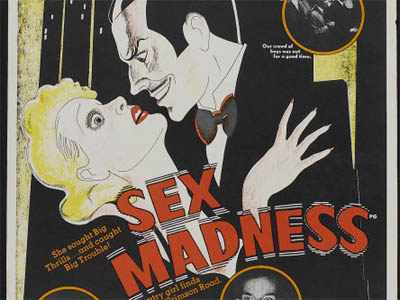
Sex Madness


USA 1938 b&w

aka Human Wreckage: They Must Be Told

Director Dwain Esper Writers Joseph Seiden, Vincent Valentini

Cast Vivian McGill (Millicent Hamilton), Rose Tapley (Mrs Hamilton), Al Rigali (Mr Hamilton), “Stanley Barton”/Mark Daniels (Wendel Hope)


Welcome to the second of our Dwain Esper festival tonight, Esper's love-hate letter to the Wages of Sin: the 1938 Sex Madness.


'Show Raids Net 11 Girls,' the headlines scream to the horror of a stern moral reformer, who blames the current war on VD on the loose morals of impetuous youth and salacious entertainment. Little does he know his son Tom is just another young bucks cavorting after hours with dancers from one of the many burlesque house. That's right, kids, this is where your great-grandfathers used to get their "education" - theatres crammed to the rafters with Girlie Shows watched by perverts, covert lesbian thrill-seekers, and those on the slippery slope who should know better.


Backstage we're introduced to two of the dancing goils - both hoping for something better, and both riddled with disease. Yes, THAT social disease! Sheila is dating Tom, though still finds time to play hostess at the many post-show house parties, barely-concealed breeding grounds for physical and moral decay. Then there's Milly, a former teenage beauty queen who left her sweetheart to try her luck in the Big Apple. Hunger and an unscrupulous manager lead to an unfortunate incident with a casting couch. There's a wild party, champagne, promises of a rosy future, and then.... A kindly doctor takes her through a hospital's venereal disease ward and shows her, warts and all, what she has to look forward to. There's still hope, however, and an out-of-town doctor promises her a speedy cure so she can return home to marry her sweetheart. The payoff: new hubby's eyesight is beginning to fail and the baby's lips are blue. Hmmm.....


At first glance, Esper's handheld, grainy b&w footage and naive performances almost pass as a cinema verite document of the Thirties' seedy underbelly. But art it certainly ain't - it's vintage exploitation oozing out of every pore and sore, and in classic exploitation style, Sex Madness wallows in the very acts it condemns. Fabrication, Titillation, Demonstration, and in that order – it’s a formula that worked for Esper and every other huckster plumping up their lurid peekshows with moral fibre. To quote Errol Morris: it's fast, cheap and out of control, with the subtlety and sophistication of a concrete enema. If only the Good Old Days were this bad, as seen in 1938's Sex Madness.


Saturday, March 8, 2008

21st March 2008: Schlock Treatment's War on Drugspolitation special!

Back in the Seventies, Anita Bryant was a popular if milktoast chanteuse who doubled as a poster girl for Florida’s orange juice industry. Her fall from grace happened after Florida passed its anti-discrimination laws against homosexuals; being violently and fundamentally Baptist, she launched a hate campaign called “Save Our Children”, declaring in a hysterical tone that all homosexuals are potential pedophiles. Naturally she lost much of her liberal audience and the backing of the Florida Citrus Commission. But that same hysterical tone can be found in an ealier scare film aimed at Florida’s primary school population: in Drugs Are Like That (c.1970), we could almost believe drugs are a greater threat to the nation’s children than homosexuals. The film opens with a pair of pre-teens making a working windmill out of Lego; take one piece out of place, and the whole edifice collapses in a plume of smoke. “Drugs are like that,” frowns Anita’s voiceover. In a series of infantile analogies, Anita hammers the point home with the subtlety of a Swedish wrestler: a toddler with a pacifier, a crying girl with her hand in the biscuit jar (“She’s not supposed to go after the cookies!”).

It’s often been said this film encouraged an entire decade of Florida kids to take up drugs. Let’s look at the facts: the film opens with a shower of Lego blocks that turn into a pharmacopeia of multicoloured pills. Mmmm…psychemedelic! The jaunty singalong theme song “Drugs Are Like That” is pure sugary candy, sticky and infectious – and shall we say addictive? And the inane dialogue between the two kids actually sounds like the rot that passes for most drug-laced conversations. Not content hooking a lost generation on Vitamin C, Anita, YOU are the pusher. J’ACCUSE!

The Terrible Truth (1951) is an early and deliriously and sensationalist film on pot (“that’s jazz talk for marijuana”) as the slippery slope to the Big H. from Sid Davis Productions, the man who gave us the Stranger Danger classics Girls Beware and Boys Beware. A disturbingly mannish Mrs Howard parades her wayward teenage daughter Phyllis like a junk monkey, fresh out of cold turkey in the county jail and a six month nightmare “even Edgar Allan Poe couldn’t have improved on!” Her tale is a strangely familiar one: she started out smoking reefers with the anti-social crowd – you know, “the ones with no backbone”. Soon she’s marrying her middle-aged boyfriend Chuck, the lovespawn of Danny Kaye and William S. Burroughs, who turns her onto dope, and she ends up dealing to support her $30 a day habit. By the grace of God she lives to tell the tale, warning against a possible Communist conspiracy to hook America’s youth. Sid uses a similar “confessional” framework using a young actress to play Phyllis – but not that great an actress, judging from her eye-rolling and troll hair pulling. Never has anti-drug hysteria been so… well, hysterical.

LSD 25 comes from that magical moment in the history of the War On Drugs: 1967, the height of the Acid Scare. A befuddled population of non-hipsters were convinced the Russians were trying to put LSD in the country’s water supply, and Timothy Leary was a psychedelic Pied Piper leading the acid-soaked rat children out of Haigh-Ashbury to their doom. LSD 25 adopts a Devil’s Advocate disguise by letting the drug itself narrate the film (“everyone knows I’m called LSD for short…”), but clearly its deceptively benign commentary hides its true purpose. “It’s high time for the facts”, LSD says, and here they are: insanity and premature death, and a freakshow of gibbering hippies on heavy bummers. “Trip or trap?” it poses over a pounding soundtrack of anti-psychedelia, the Sixties equivalent of Christian metal. LSD simply shrugs. “That’s his problem, not mine.”


Narcotics: Pit Of Despair (1967) is from the same proto-hippy period, a catch-all hysterical tome for its complicated times. From beer to a pot party and then straight into heroin hell, it’s the story of John Scott, a self-absorbed jock and born shirker who, failing exams and looking for kicks, goes to what pusher Pete tells him is a beer party. Before you can say “frathouse freakout” he’s seduced by Pete’s junky girlfriend into having just one puff of reefer – to “take a trip from squaresville”. Soon Pete has his hooks into John – once his defences are down and his character has crumbled, he introduces him to horse. Soon it’s dirty backrooms and eyedropper syringes as the music suddenly turns sinister, and the drugs-as-snake poison references (with all the inherent serpent-as-Satan suggestions) become relentless, as does the hysterical narration from a jive-quoting square. The barrage of clichés - “the trippers, the grass hoppers, the hip ones” – rolls endlessly off his NBC-trained silver tongue and continues right to the bitter end. End? There is NO END.

Beat Girl

UK 1960 b&w

aka Wild For Kicks

Director Edmond T. Gréville Writer Dail Ambler

Cast Gillian Hills (Jennifer), Noëlle Adam (Nichole), Adam Faith (Dave), Christopher Lee (Kenny), Nigel Green (Simon), Shirley Anne Field (Dodo), Oliver Reed (Plaid Shirt)

It’s Youth Gone Wild – Anglo style – in a British charicature of the juvenile delinquent movie, with a voguish quasi-beatnik flavour.

The Beat Girl of the title is Jenny, absent art student and spoilt daughter of a distant father more interested in his model city than his new wife, a 24 year old French coquette named Nichole. Jenny spends all of her time looking for new kicks, shimmying to jazz and rock combos and hanging out with her “beat” friends at a Soho boho coffee shop. Much to Jenny’s horror, in walks Nichole, whom the hip crowd label the “Paris Poodle,” and who becomes the target for the unloved Jenny’s teenage rage. Nichole, meanwhile, is recognized by the jaded exotic dancers at “Les Girls”, the strip club across the road run by cold-blooded impresario Christopher Lee, who takes more than a professional interest in the still-innocent Jenny. Dark pasts and uncontrolled libidos naturally converge in a predictably downbeat and moralistic ending in the shadow-filled back streets of London’s Soho.

If it’s kicks you’re after, Beat Girl’s are of the restrained kind, thanks to its immovable British-ness, where barely a stiff upper lip moves let alone any other part of the anatomy. It’s a foreign culture, even it’s from America, that’s been transplanted and sits uneasily; we’re used to seeing jive-spouting coffee shop crawlers in juvenile delinquent movies, but not when they have plums in their mouths. England’s answer to Elvis, Adam Faith, sounds convincing with a guitar in his hand, but give him a page of dialogue and he sounds like Michael Caine in Alfie.

Unlike American JD films of the period, there’s depth in the film’s characters and the cast is uniformly good, even Faith, and the ever-pouting Bardot-esque Gillian Hills as Jennifer. Most memorable is the soundtrack, a mod concoction of jazz, rock and big band orchestrals from the John Barry Seven, the future composer of the James Bond theme, whose hypnotic Beat Girl title track could be one his greatest compositions.

Whether it’s Wild For Kicks (its American title) or Mild For Kicks, it’s still a fascinating trans-Atlantic hybrid of Marlon Brando and BBC Play of the Month: the1960 Beat Girl.

Monday, March 3, 2008

29th February 2008: Drugs and Bikers Counterculture double!

The Rebel Rousers

USA 1967 [released 1970] colour

Director Martin B. Cohen Writers Martin B. Cohen, Michael Kars

Cast Cameron Mitchell (Paul Collier), Bruce Dern (J.J. Weston), Diane Ladd (Karen), Jack Nicholson (Bunny), Harry [Dean] Stanton (Randolph Halverson), John 'Bud' Cardos (Townsfolk)

Welcome to our Counterculture special on Schlock Treatment – hippies, bikers, and surly Mexicans all vie for screen time in a three hour non-stop sticking it to the Man-a-thon.

The Rebel Rousers is a prime example of biker nastiness from 1967. There were biker films before – The Wild One with Marlon Brando, Russ Meyer’s Motorpsycho – but Roger Corman’s The Wild Angels from 1966 cemented the genre, and for the next five or six years there were scores of them, while square audiences got their kicks vicariously. Usually told from the biker’s point of view, it’s about frontier freedom, with all the inbuilt philosophical flaws and inconsistencies, and the genre found its zenith in Easy Rider – Peter Fonda and Dennis Hopper representing the Death of the American Dream, and Jack Nicholson as a booze-soaked lawyer providing the running commentary.

The Rebel Rousers is a different breed, told mostly from the point of view of Paul Collier (Cameron Mitchell), a Joe Sixpack architect who chases his pregnant girlfriend to a sleepy coastal town, and runs into former football team member JJ (Bruce Dern), now gone to seed and cracking skulls with his biker gang the Rebel Rousers. JJ says it’s all about doing his own thing, being “where it’s at” and other well-meaning hippie aphorisms, but the other gang members including the stripy-panted Bunny (Jack Nicholson) are after much darker kicks, and drag Paul and his girlfriend Karen (Diane Ladd) from their stalled car for a round of Beach Blanket Bingo. After almost constant bickering, like petulant children with ADHD, JJ agrees to a bike race along the beach to see who scores the pregnant Diane Ladd for the night. Sure, he’s a biker with a conscience, but pragmatism rules their bizarre universe.

Filmed in 1967 but not released until 1970, Rebel Rousers is the Last House On The Left of biker movies, switching between grimness, absurdity and soap operatics with alarming regularity. Without the visual flair of Roger Corman, and minus the fuzztone squall of Davie Allan and the Arrows, it’s a fairly anonymous effort that just happens to have an outstanding cast: Nicholson, of course, perched on cusp of stardom after 10 years of juvenile delinquent and biker films; Harry Dean Stanton, already in his forties, playing an aging delinquent with his usual slurred genius; and Bruce Dern, a staple of the biker genre whose narrow features lend themselves perfectly to his sneaky anti-social weasel characters. The Rebel Rousers also marks the first screen appearance of Laura Dern inside the very pregnant Diane Ladd, Dern’s then-wife, both of whom were obviously shagging like rabbits on the set of The Wild Angels.

As Peter Fonda says in The Wild Angels, “We wanna be free to ride our machines and not get hassled by the Man… and we wanna get loaded!” Amen to that brother, as we fire up the hogs on Fonda’s fussin’, feudin’ cousins The Rebel Rousers.

Acapulco Gold

USA 1973 colour

Director Bob Grosvenor

Our next film was a campus favourite in the Seventies, a pot fetishist’s sticky dream. In the filmmakers’ own words, Acapulco Gold from 1973 is a “modern-day adventure” telling the inside story on the marihuana trade – the growing, harvesting and smuggling of the VERY illegal wacky weed. I still remember posters for this outside the Classic Cinema and the Boomerang right up until the early 90s, proving old hippies never die – they just can’t remember what they’ve watched. Ideal viewing conditions for Acapulco Gold would be in the old Schonell Cinema in the mid 70s, the air sticky with green smoke, listening to the collective roar every time a particularly bushy plant tickles the audience’s fancy.

While the film protests (a little too strongly) that it’s impartial, it quickly turns into a comprehensive how-to manual for budding entrepreneurs; all that’s missing from the picture is Cheech and Chong’s marijuana van from Up In Smoke (now THAT’s how you smuggle pot into the States!). There’s tips on concentrating THC with dry ice and how to swim past the border patrol, and you find the going rate in Acapulco, the “superweed” capital of the world, is just $30 a kilo. “Out of sight!” mutters our gringo smuggler from under his headband, and then from out of nowhere a vaguely Robert Crumb-esque cartoon sequence kicks in amidst a sea of animated pot clouds. Crazy. On a brief detour to revisit the hemp trade of the Twenties, grizzled old-timers and oblivious Oakies compete for screen time with hipster doofusses (or is that doofii?), all of whom are decked out in a staggering array of Seventies garb.

Make no mistake, this is pornography for potheads, and if you don’t believe me, check out the opening’s shots of a fresh-faced nature girl wandering through a field of marijuana, picking sticky buds instead of flower buds. By avoiding the hysterical preachy moralizing of drug scare films like Reefer Madness it swings the other way into canonizing its subjects, the seemingly endless talking heads of anonymous stoners. Personally I suspect the filmmakers are a little fond of the “reefer” as interviews go on far longer than a non-THC addled brain can handle. And I swear, if I hear the words “out of sight” one more time there will be hippie blood on my hands.

Technically as raw as a two-day orgy and with a soundtrack by perennial head favourites The Flying Burrito Brothers and a nation of Neil Young pretenders, it’s a trip back to a time no doubt long forgotten by all concerned: the 1973 head film Acapulco Gold.

Saturday, December 22, 2007

12th January 2007: Thirties Drug Scare triple!

Assassin Of Youth

USA 1937 b&w

Director Elmer Clifton Writers Charles A. Browne, Elmer Clifton, Leo J. McCarthy

Cast Luana Walters (Joan Barry), Arthur Gardner (Art Brighton), Fay McKenzie (Linda Clayton), Michael Owen (Jack Howard)

Greetings teetotallers to a special Schlock Treatment triple bill of Thirties Drug Scare or “Drugsploitation” anti-classics. SEE Drug orgies! SEE Sex-crazed maniacs! SEE what your great grandparents were doing while your great great grandparents were too hopped up on Prohibition gin to even notice!

All three films were made in the mid to late Thirties, at the same time as the textile and pharmaceutical companies wanted hemp and medicinal marihuana off the market. Conspiracy? No. But yes. They would have banned jazz too if they could, and beatniks would have been listening to Perry Como. The horror...

From a sociological point of view (and we at Schlock Treatment will always take the academic high road), Assassin Of Youth (1935) is an interesting look at the seedy underbelly of small-town Americana. A young girl inherits her grandmother’s wealth, and before long the local dope fiends are introducing her to the Devil’s Weed: the reefer is torched, the skirtlines go up, and as logic dictates, they’re soon doing the Horizontal Watusi.

Director Elmer Clifton specialized in these kinds of sordid cheapies (Slaves In Bondage, Paroled From The Big House...). All true stories? No. But yes. And with so many unintentional laughs it’s criminal, I hurl at you kicking and screaming, 1935’s Assassin Of Youth.

Marihuana, The Weed With Roots In Hell!

USA 1936 b&w

aka Marihuana, Marihuana The Devil's Weed

Director Dwain Esper Writer Hildegarde Stadie

Cast Harley Wood (Burma Roberts), Hugh McArthur (Dick Collier), Pat Carlyle (Tony Sentello), Paul Ellis (Nickolas 'Nicki' Romero)

We continue our dizzying downward moral spiral with Drug Scare classic #2, Marihuana The Weed With Roots In Hell (1936), springing from the demented imaginings of Dwayne Esper, who did a similarly deranged treatise on schizophrenia in Maniac (1934) and on the effects of venereal disease in Sex Madness (1938).

In Marihuana..., we have four young girls, a beach party, skinny-dipping - what could lead these girls even further down the path to depravity than (cue stern voice) “a certain narcotic”. Burma our heroine (no pun intended) goes from proto-hippy to smack dealer in just under an hour. Yes, I say, it’s all because of the weed with its roots all the way to hell, and we will prove it with Marihuana The Weed With Roots In Hell. What’s in a title? Everything!

Reefer Madness

USA 1936 b&w

aka Tell Your Children

Director Louis J. Gasnier Writers Lawrence Meade, Arthur Hoerl, Paul Franklin

Cast Dorothy Short (Mary Lane), Kenneth Craig (Bill Harper), Lillian Miles (Blanche), Dave O'Brien (Ralph Wiley)

Do we dare one more in our Thirties psychedelic triple header? As the blonde hussy in Assassin Of Youth declares, “One more puff and we’ll all be floating!” And what have we learnt so far? For one, everyone involved in these films is either dead or close to dying. Coincidence? I think not.

And with that thought, I leave you with the greatest, most insane and best known drugsploitation film of all, originally billed on Australian video with Cocaine Fiends (1936) and which should be shown in fast forward for maximum effect (“Play faster! Play faster!”) - the 1938 Reefer Madness. Adios, and stay clean.