Showing posts with label euro trash. Show all posts

Tuesday, May 24, 2011

Arcana (1972)

Arcana

Italy 1972 colour

Director Giulio Questi Writers Giulio Questi, Franco Arcalli

Cast Lucia Bosé (Mamma), Maurizio Degli Esposti (Son), Tina Aumont (Brenda), Renato Paracchi

Giulio Questi

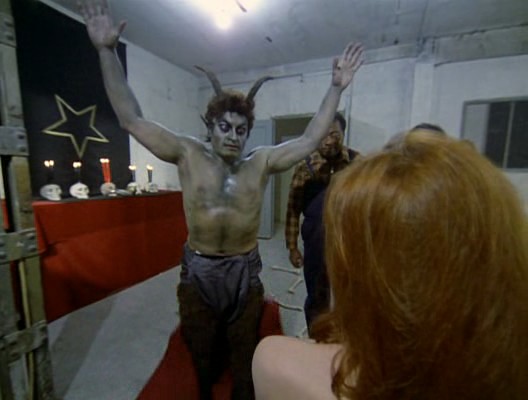
“The bones, the bladder..” whispers a midget into a young man’s ear, while a woman licks a doorway. Yes, I’m proud to say, it’s going to be one of those nights as we delve into the bizarre world of renegade Italian director Guilio Questi and his strangest film of all, the 1972 horror movie Arcana.


Questi is a fringe figure in Italian cinema, creating films which straddle the populist genre and elitist art divide and finding himself an outsider in both worlds. In a career since the Fifties he’s completed no more than five theatrical features, working in television and documentaries. A self-avowed anarchist, his radicalized politics is ever-present in his grimmest film, the apocalyptic spaghetti western Django Kill from 1967, and in his capitalist giallo thriller set on a chicken farm from 1968, the appropriately named Plucked!, or Death Laid An Egg. His is an uncompromising stance, and is thus: never let the audience, or a logical story for that matter, get in the way of the pursuit of one’s art.

Curiously, Arcana – on the surface his least political film - has dropped out of circulation since its 1972 premiere, and one can only wonder what a cine-literate Italian crowd weaned on Fellini’s eccentricities would have gleaned from it. The film starts off benignly enough in a Rome apartment occupied by a fortune teller. On the surface she’s a charlatan, milking good lire from her customers from carefully-staged group psychodramas – a kind of primal scream therapy, only with pissing and shitting – presided over by her freakishly insightful son Mario. He truly has inherited his mother’s divine gifts, but manifests them in more disturbing fashions. His myriad of unhealthy obsessions include dead animals or animal parts, visiting the subway tunnel his railway worker father died in, stealing photos and objects from his mother’s customers and creating elaborate charms with them, and crawling into bed with his mother or slicing her breast with a kitchen knife. A visit from a young woman engaged to an older man and worried about her future seals her fate, and in her Mario finds himself the perfect doll to stick his pin in. Figuratively speaking, of course.

The key is in the film’s title – arcane, or esoteric, or more specifically the major and minor arcana making up the deck of Tarot cards, used for divining and revealing hidden knowledge. The film, Questi states in the opening, is “not a story, but a game of cards”. Both the start and the epilogue, he continues, are not to be believed; as the film is spilt into two parts, like the Tarot itself, one might suspect that the entire narrative is a lie. “You are the player,” says Questi, suggesting everything contained herein has a hidden meaning to be decoded. “Play smartly and you’ll win.”


Arcana is as much a horror film as David Lynch’s Eraserhead. While Lynch’s brand of nightmarish surrealism has found its way into post-modern pop culture, the eternal fringe-dweller Questi’s is of a much darker, more unsettling variety. Just when your feet are back on surer footing, the flowers start to die, the cards flip themselves over, children worship eggs or stick skewers in a bread homunculus, a donkey is hoisted up a building, and you are left the Hanging Man of the Major Arcana deck, caught halfway between revelation and damnation.


Arcana’s a rough ride, at times a Freudian avalanche-of-conscious imagery, and it’s in the second half the film veers off its rails and plows into much darker territory, past Fellini and into the domain of Bunuel, a universe of sex, death, politics, decay, deformity, and the “other world” which hangs over the film like a funereal veil. If you’re not a fan of demented art cinema of the Seventies, we’ll see you next week. For those with more metaphysical tastes, we invite you into the hidden world of Arcana.


Thursday, December 23, 2010

19th December 2010: War Of The Zombies (1964)

War Of The Zombies

Italy 1964 colour

aka Rome Against Rome, Roma Contro Roma, Night Star: Goddess Of Elektra

Director Giuseppe Vari Writers Ferruccio de Martino, Massimo de Rita, Piero Pierotti, Marcello Sartarelli

Cast John Drew Barrymore (Aderbad), Susy Andersen (Tullia), Ettore Manni (Gaius), Ida Galli (Rhama), Mino Doro (Lutetius), Ivano Staccioli (Sirion), Philippe Hersent (Azer)


“Unconquerable warriors of the damned!” screams the US poster for War Of The Zombies. “SEE the undead cross swords with the living! SEE the goddess of the night whose gaze mummifies men!” Sounds to me like the premise for one of the most incredible horror films ever. Imagine then your reaction when the film unspools and it’s YET ANOTHER ITALIAN SWORD AND SANDAL MOVIE! As if American theatre screens and televisions weren’t inundated enough in the early to mid Sixties with peplum-themed product, the films’ distributors – in War Of The Zombies’ instance, American International Pictures – were forced, as the peplum cycle was grinding towards its demise, to primp up or flat-out lie about their content.


Luckily War Of The Zombies from 1964 is not just another Sons of Hercules muscle-fest, but an ambitious fantasy-horror ranking comfortably near Mario Bava’s Hercules In The Haunted World and Riccardo Freda’s The Witches Curse. In War Of The Zombies, however, there’s no Hercules, Samson or Ursus as the beefcake-flavoured focal point. Instead the film’s hero is Roman centurion Gaius, sent without his troops to the troubled Salmacia province to investigate Rome’s missing tribute. In the opening sequence Roman troops carrying treasure from Salmacia back to Rome are butchered by barbarians, stripped of their armour and their bodies stolen by deformed scavengers. It appears the entire province, including its weak Roman pretern Letitius and his double-crossing snake of a wife Tullia, is under the spell of a devilish cult dedicated to the Moon Goddess and “daughter of Isis”, whose Oath of Blood is performed under the blazing high beam of its enormous stone bust’s single Third Eye. Through Letitius’ slave girl Rhama, held in a trance by the cult’s high priest Aderbad, Gaius learns of its plan to revive the spirits of the dead Roman soldiers and lead them into an ultimate showdown against their own living comrades.


Sounds incredible, and to a certain extent it is. This IS a peplum, let’s not forget, and as such there are dry patches of wooden dialogue and stiff-as-corpses emoting to suffer. Once we wade through the regulation courtships and betrayals, however, we’re presented with the payoff: a magnificent low-rent but surprisingly effective battle between the living and the dead, smothered with superimposed colour swirls of saturated reds and blues (Mario Bava’s favourite palette for supernatural effects). Rather than rotting corpses, the Moon Goddess’ army is presented as ghostly figures, their otherworldliness underscored by slow motion cameras and an eerie echo-laden soundtrack. Just as impressive is the over-the-top performance of their leader, high priest Aderbad, played by John Drew Barrymore (son of John Barrymore, father of Drew Barrymore) in one of his numerous Italian film appearances between numerous cocktails in the early Sixties. Quasi-psychedelic, and several notches above your ordinary Italian sword and sandal, is the zombie-themed peplum chiller Rome Against Rome, or War Of The Zombies.


Sunday 5th December 2010: Return Of The Evil Dead (1973)

Return Of The Evil Dead

Spain 1973 colour

aka El Ataque De Los Meurtos Sin Ojos/“Attack Of The Eyeless Dead”, Return Of The Blind Dead, Revenge Of The Evil Dead

Director/Writer Amando de Ossorio

Cast “Tony Kendall”/Luciano Stella (Jack Marlowe), Fernando Sancho (Mayor Duncan), “Esther”/Esperenza Roy (Vivian), “Frank Blake”/Franco Brana (Dacosta)


Just as George Romero changed the face of zombie cinema with his groundbreaking Night Of The Living Dead (1968), Spanish director Amando de Ossorio gave them a distinctly European neo-gothic makeover in a series of four films from 1971 to 1975. Known as the Blind Dead Quartet, the films feature the reanimated skeletal remains of the Knights Templar, keepers of the secrets of eternal life and now unstoppable killing machines on undead horses and clad in their Templar garb. Their skull features blazing empty eye sockets require them to find their victims entirely by sound...the trick is to not scream their lungs out at their ghastly appearance!


Tonight's film Return Of The Evil Dead is the second in the Quartet, following on the bony heels of Tombs Of The Blind Dead (1971), while completely reinventing its Templar back story, as the whimsical de Ossorio did with each entry. This time the blood-drinking, human sacrificing Templars are holed up in an Abbey in the Spanish town of Berzanzo, their eyes burnt out by angry villagers and set on fire – but not before a curse falls upon their descendants. Five hundred years later and the townsfolk of Berzanzo are happily celebrating the anniversary of scouring the Templar devils from the face of the Earth. Night falls, dry ice oozes from the ruined Abbey, and skeletal hands covered in rotting cowls slowly emerge from their tombs...


Back in Berzanzo, it's certainly no Fourth of July Picnic. The town's corrupt Mayor is busy ordering his goons to beat up Jack Marlowe, the American fireworks technician and ex-lover of local sexpot Vivian, whom the Mayor and at least one of his goons have their greasy eyes on. As the Templar's mummified army reaches the town square and hacks its way through the festivities, the core survivors seek sanctuary in a church, and then turn on each other one by one. It's like Hitchcock's Lifeboat (1944) – the tight confines bringing out the characters' latent jealousy, greed, selfishness and inhumanity – if zombies were clutching at the side of the raft. Particularly repellent is the Mayor, who thinks nothing of using his constituents as Templar bait. Vindication is the Templars, and the world finds itself a few assholes fewer.


As a film, Return Of The Evil Dead is much more suspenseful than a skeleton army in sackcloth should engender. The very appearance of the undead Templars and their modus operandi (blind but not deaf, my sweet pointed coccyx!) require a very serious leap of faith on the part of its audience, and yet, with those iconic soiled hoods and grinning skulls, they can't help but disturb. De Ossorio recycles many of the first Blind Dead's aural and visual tricks, such as the jarring slow-motion shots of the Templars on zombie horseback reinforcing their otherworldliness, and the soundtrack dripping with low moans and pitch-shifted bells. The set pieces are nothing short of fantastic: the village square massacre, the fate of hunchbacked cripple Murdo, and in an obvious nod to another Hitchcock film The Birds (1963), the young girl's heartstopping walk through the zombie sentinels (ALWAYS remember that in the case of an undead Armageddon, children are the weakest link). There are moments of intentional humour – the scenes with the governor and his saucy maid are nicely handled – but overall the tone is grim to the point of apocalyptic, and like other Spanish horrors of the early Seventies, equal parts gothic atmosphere and modern gore-soaked shock tactics.


“You have to be quiet!” yells one character, and I hope you do the same. Sit very still, and don't utter a sound until the end of Return Of The Evil Dead.


Wednesday, December 22, 2010

31st October 2010: Horror Express (1972)

Horror Express

Spain/UK 1972 colour

aka Panic In The Trans-Siberian Train, Pánico En El Transiberiano

Director “Gene”/Eugenio Martín Writers Arnaud d'Usseau, Julian “Halevy”/Zimet

Cast Christopher Lee (Prof. Sir Alexander Saxton), Peter Cushing (Dr Wells), Alberto de Mendoza (Father Pujardov), Silvia Tortosa (Countess Irina Petrovski), Telly Savalas (Captain Kazan), Helga Liné (Natasha)


Tonight's film takes me all the way back to 1979, when I was a nine year old kid living in Bahrain. Betamax had arrived in the Middle East, and suddenly all of the films I was previously denied access to were there, on seventh or eight generation dupes, distributed though the network of pirate video stores I would later call the Betamax Grapevine. Horror was the vine's forbidden fruit, and I started to gorge myself: slashers, Italian gore movies, The Texas Chainsaw Massacre, and then Hammer films, and those of Britain's horror superstars Christopher Lee and Peter Cushing. No matter what dire projects they lent their marquee value to, Lee and Cushing would always give their roles a certain class and gravitas, and in the midst of the filmic chaos a dignified retreat. It was early in this voyage of discovery that I stumbled upon the two playing turn-of-the-century scientists battling a brain-sucking Neanderthal on the Trans-Siberian Express. The film was called Horror Express from 1972, and I went bananas over it.


It's always a terrifying moment going back to those defining moments in your childhood, only to discover you were so far off the mark. Not so with Horror Express. I hadn't seen the film in thirty years, yet I remembered it almost scene by scene. It's every bit as bizarre as I recalled, and just as classy. Christopher Lee is note-perfect as a humourless fossil expert Alexander Saxton jealously guarding his latest acquisition in Arctic Siberia – the intact body of a primitive man encased in ice. It arouses much interest, not least from a nosy fellow scientist Dr Wells played by Peter Cushing, with whom he reluctantly ends up sharing a carriage on the Trans-Siberian Express back to Europe. A thief at Shanghai's station, then a baggage attendant, quickly discover the body is no longer frozen – and whose glowing eye sucks out their memories, leaving the victims' eyes white and ringed with blood, and their brains smooth as an egg. Agh, those eyes! They've haunted me since childhood, and no matter how often the brain-suckling scenes are repeated, they still unnerve me.


It's an alien intelligence in the body of the caveman, or possibly something much darker. The first person to notice the stink of true Evil is a Rasputin-like monk with more than a passing resemblance to the late great Paul Naschy, little more than a trained monkey in the employ of a Polish Count and his flirtatious wife, who spends much of the film's running time throwing herself at the disinterested Lee right under her husband's nose. The wide-eyed mystic believes the creature in the trunk is Satan himself walking amongst mankind, and readily abandons his faith to learn the creature's power and drink greedily from its endless well of knowledge. “Science is immoral”, the Countess reasons with the amoral Darwinist Lee, and it's this clash of Godless science and faith, superstition, and the age-old belief that knowledge is inherently evil – the apple in the Garden of Eden, the hidden eleventh branch on the Kabbalah's ten branch Tree of Life, the yawning Abyss representing the absence of God and thus Satan himself - that gives a counterweight to the rest of the film's jibber-jabber and brain sucking.


The real revelation of Horror Express is Kojak's Telly Savalas as the cossack officer, and quite possibly steals the show screaming “Peasants!” at the passengers and gargling vodka like listerine. For a cheaper, less polished version of Hammer's more distinguished productions, the period detail is extraordinary, particularly in the Shanghai station sequences, and as expected Lee and Cushing's presence balance the film's spiralling lunacy, the strain almost palpable as they soldier through the polyphonous babble of pseudo-science and peer through microscopes at line drawings of pterodactyls. And as if it couldn't get any stranger comes an ending so out of left field, and such pure Grand Guignol, it firmly cements the film as one of my favourite horror films of all time.


Sometimes it's good to revisit an old friend, especially on those special times of the year. From all of us at Schlock Treatment, Happy Halloween everyone, happy All Saints Day tomorrow, and have a ghoulish Day Of The Dead on Tuesday, as we take you for a night journey on the Horror Express.


Saturday, May 15, 2010

Sunday 20th June 2010: Visible Agent 000!

Visible Agent 000


Greece 1967 b&w

aka Voitheia O Vengos, Faneros Praktor '000'

Director Thanasis Vengos Writers Napoleon Eleftheriou, Nikos Tsiforos

Cast Thanasis Vengos (Athanasios Bobas aka “Thou Vou”), Zannino, Dimitris Nikolaidis, Lavrentis Dianellos (Psaltis)


Hola everyone, and welcome to the final in our three film Spies-A-Go-Go tribute. Tonight we venture for the very first time into vintage Greek cinema with a very strange spy spoof, and living proof that no country was immune to Bondmania: the 1967 Visible Agent 000.


Every country has its own Jerry Lewis lurking in its cinematic past, and Greece's model was Thanasis Vengos, an odd, hairless rubber ball of chaos, resembling a seal in a bald wig, or the human equivalent of Jon Lovitz's cartoon character The Critic. Unlike the regulation cheerful, loveable innocent of the comedy world, Vengos is a true Everyman: arrogant, pompous, oblivious to the trail of wreckage he creates, and resolute in the face of overwhelming evidence that he's a hopeless fool. It's a dangerously physical schtick, all performed without a stunt double, that made him Greece's most popular film comedian of the Sixties and into the Seventies, during which he broadened his range to more dramatic roles. Visible Agent 000 from 1967 sees Vengos at his peak commercially and artistically, and like the great Jerry Lewis before him, takes on the director's reins at the same take as letting himself well and truly off his leash.


At the James Bond School for Spies, Vengos plays Thou Vou, a walking disaster zone and just one of a series of would-be 007s who are put through the rigours of training. The final phase before graduation is a series of three tasks, each of which is marked out of ten to give the agent's number. So you can imagine how “visible” or “apparent” agent Triple Zero performs – tailing a businessman's daughter suspected of espionage, the theft of fashion patterns by an inside mole in Nana Mouskouri glasses, and most complicated of all, retrieving a microfilm from a cakeshop, which turns into the Athens Cake Shop Massacre.


As a Bond spoof, it's an absolute riot. The shadow of Sean Connery is everywhere, from the portraits on the wall to the school's name (right next door to the James Bond Kindergarten for Spies!), and to the numerous lapses into Monty Norman's instantly recognizable theme music – sadly, not played on bazoukis. There's an exasperated M, a blonde and leggy Miss Moneypenny, and a Q who offers Thou Vou a briefcase full of indispensable gadgets, including clothes pegs, a Swiss Army knife and a supply of contraceptives. Proving he's a master of concealment, he stalks his female suspect first as a mobile bale of hay, then as an overgrown child on a scooter, and as a gypsy violist with a trained monkey and tape recorder strapped to his wrist...


...All of which may sound about as funny to you as an episode of Acropolis Now. Like many non-English language comedies it won't be to everyone's taste, and much of the humour is, I suspect, lost in the translation. Luckily for us, Vengos is adept at channelling the previous fifty years of comedic genius: the Marx Brothers' surreal visual gags, the physical comedy and pathos of Chaplin and Keaton, and let's not forget the bastard child of them all, the infantile dementia of Jerry Lewis. The result is surprisingly effective, a frantic farce replacing “what the...?” moments with genuinely witty and supremely silly gags in rapid-fire succession. There's also romance and even a Sixties pop number WITH bazoukis, all in an imaginatively filmed and crisp black and white print. It's certainly one of the strangest back alleys we've peered down as we chart the most obscure corners of Bondmania – the 1967 Visible Agent 000.


Sunday 6th June 2010: Kiss Kiss...Kill Kill!


Kiss Kiss…Kill Kill


Italy/Hungary 1966 colour

aka Kommissar X - Jagd auf Unbekannt

Director “Frank Kramer”/Gianfranco Parolini Writer Werner Hauff

Cast Tony Kendall (Jo Louis Walker/Kommissar X), Brad Harris (Captain Tom Rowland), Maria Perschy (Joan Smith), Christa Linder (Pamela Hudson)


Back in the heady days of Sixties genre cinema, each country had their pulp heroes. Italy's Bond knockoffs were too numerous to mention (at last count there were close to a hundred!), France had its post-war agent OSS 117, and in West Germany, two series of phenomenally popular crime novels were turned into successful spy-like film franchises – the Jerry Cotton series, and Kommissar X. The books feature New York private detective Joe Walker, a slightly greasy womanizer in a cheap looking suit, in a constant one-upmanship contest with the frustrated policeman Captain Rowland.


Kiss Kiss...Kill Kill from 1966 was the first film out of seven, featuring American actors Tony Kendall as Walker, and Hercules muscleman Brad Harris as his second banana (and after looking as uncomfortable as an ape in a tux, is eventually given a chance to flex his pecs). Released at the height of the spy craze, it takes very little tweaking to make a crime pulp fit the new formula – an exploding pen here, a miniaturized golf buggy there, a villain's promotion to SUPERvillain – and in the spirit of the Sixties' pan-European co-operation, it represents an Italian-Hungarian production of a German creation of an American character, dubbed into English.


Joe Walker is called to an unnamed European paradise to investigate a missing scientist, and is drawn instead by a beautiful secretary (Spanish horror icon Maria Perschey) into protecting her employer, a former gangster turned millionaire industrialist whose former associates are being eliminated one after the other (one by exploding tennis balls!). The culprit, it appears, is a criminal mastermind holed up on an island lair complete with a private army of goons in red polonecks and machine guns, wigged out femmebots (take THAT, Austen Powers!), and a cache of radioactive gold with which to take over the world. Everything's gold – the gold wigs, the lame sweaters, the Goldfinger references – but the REAL gold is watching an army of liberated femmebots on the loose.


True, it's cliché upon cliché, and even in 1966, decades before Austin Powers, those conventions were already old hat, but for the goofy at heart, Kiss Kiss...Kill Kill is a treat: a blissfully and almost insanely simple-minded pulp-pop pastiche of Bond iconography. Allusions to its inspirations are numerous, from Walker's car groaning with gadgets to the line, “This place is done up in early Ian Fleming!” There's also a theme song, like every good spy film should have, which positively reeks of Nancy Sinatra... “I love you Joe Walker, just like every woman loves you!” And seriously, with the sports cars, the exotic locales, and a cat like Kendall, all Connery angles without a snifter of charisma, how could you resist? Time to pucker up and bunker down for Kiss Kiss...Kill Kill.


Monday, December 28, 2009

Sunday 10th January 2010: Vengeance Of The Zombies!

Vengeance Of The Zombies


Spain 1973 colour

aka La Rebelión De Las Muertas, Walk Of The Dead

Director León Klimovsky Writer “Paul Naschy”/Jacinto Molina Alvarez

Cast “Paul Naschy”/Jacinto Molina Alvarez (Krisna/Kantaka/Satán), Rommy (Elvire Irving), Mirta Miller (Kala), María Kosti (Elsie)


Hola everyone and welcome to Schlock Treatment's second Grindhouse 101 features, a tribute to the King of Spanish Horror as we say farewell to Paul Naschy, who passed away at the end of November aged 75.


Paul Naschy, born Jacinto Molina Alvarez, was a musclebound bit player in Spanish films until his breakthrough role in 1968's Nights Of The Werewolf cast him not only as doomed lycanthrope Waldemar Daninsky, but also as a Spansh successor to horror legends Lon Chaney Sr, Boris Karloff and Bela Lugosi. It began a string of genre roles for Naschy throughout the Seventies and early Eighties in which he reinvigorated horror icons such as Count Dracula, the Mummy, Dr Jekyll and many others by drenching them in blood, sex and sadism for a hip, thrillseeking Euro audience. While never a “name” like Christopher Lee in Britain or America, the actor, writer and sometime director was considered a Horror Renaissance Man throughout Europe, who naturally took Naschy to their bloodied and naked bosom.


Tonight's film, Vengeance Of The Zombies from 1973, sounds suspiciously like yet another European reworking of Night Of The Living Dead, and considering Spain's other contributions to the undead genre at the time – The Living Dead In Manchester Morgue, or Armando de Ossorio's Blind Dead quartet – it's a fair call. Vengeance..., however, reveals Naschy's classical leanings towards the voodoo zombie from the Thirties and Forties – think White Zombie or I Walked With A Zombie. It's the tale of two brothers, both played by Naschy: one a self-styled Indian mystic named Krishna operating out of a remote British country mansion, and his horribly twisted and vengeful twin Kantaka (shhh... just forget I told you that bit!). Krishna is followed to the house – supposedly an accursed place known as The Devil's House - by Gloria, his most ardent admirer, who is plagued by visions of her dead cousin Elvira. Her father is found hanging, her butler's stabbed, and all gnarled and rotting fingers point to a curse upon her Irving family, in which the recently deceased members are resurrected by some dastardly Black Magic and used as the tools of a terrible revenge.


In Naschy's script, there are no George A. Romero style flesheaters, just proposterous white-faced “corpses” in diaphanous burial shrouds. To be honest it's a strange and slightly unsettling mix: an attempt to blend the lyricism of a Forties' Val Lewton chiller will the charnel house demands of a Seventies shocker. So when the shocks come – and trust me, they come in faucets – they tend to seem that much more shocking. However there is an unmistakable style AND charm to Vengeance... in the slow motion shots of the female zombies, the surprisingly graphic Satanic ceremonies, and I suspect the slightly po-faced notion Naschy and director León Klimovsky both held that they were making “art“ rather than a silly and simplistic horror movie. The English dubbing makes Naschy appear a little wooden at times, but there's no denying he cuts a striking figure, either as the swarthy, long-haired Krishna, the scarred Kantaka, or in this third appearance in the film – as the Devil himself! And seriously, once you've played the Big Boss, there's nowhere else to go...


Naschy continued his career into the Eighties, where both he and the Spanish film industry hit an all-time low. His film appearances, usually in token horror roles, were sporadic, and it was only in the last few years that his career accelerated once more. Sadly Paul Naschy passed away on November 30th 2009 after a long battle with pancreatic cancer. The King of Paella Horror is no more – long live the King, as Schlock Treatment pays tribute to Paul Naschy with the 1973 Vengeance Of The Zombies.


Friday, May 15, 2009

2nd August 2008: Mario Bava and Christopher Lee double

The Whip And The Body

Italy 1963 colour

aka La Frusta E Il Corpo, What, Night Is The Phantom, Son Of Satan

Director “John M. Old”/Mario Bava Writers “Julian Berry”/Ernesto Gastaldi, “Robert Hugo”/Ugo Guerra, “Martin Hardy”/Luciano Martino

Cast Daliah Lavi (Nevenka Menliff), Christopher Lee (Kurt Menliff), Tony Kendall (Christian Menliff), “Isli Oberon”/Ida Galli (Katia), “Alan Collins”/Luciano Pigozzi (Losat)


We are proud to present two early films from the master of Italian horror Mario Bava, both starring the legendary Christopher Lee. First is a gothic melodrama with a lurid undercurrent of sexual perversion: The Whip And The Body from 1963, was made after his early masterpieces of gothic horror Black Sunday and Black Sabbath, and while not as well known, will certainly be a memorable one here on Schlock Treatment.


As a horror tale the gothic elements are amplified: a family riddled with guilt, jealousy, betrayal, not to mention incest and madness. Disgraced nobleman Kurt returns to the family castle to find his brother Christian is marrying his former sex slave (and family member) Nevenka. The family still hasn’t forgiven Kurt for seducing the servant’s daughter Tania who subsequently killed herself. Every member of the family and staff have a motive for killing Kurt, so when he is stabbed through the heart with Tania’s dagger, no one is surprised. That is, until Kurt returns and continues his sado-masochistic obsession with Nevenka from beyond the grave. “Why do you torture me?” she implores a red gel-soaked phantom Kurt, while the family is picked off one by one in the ultimate love-hate death pact. Other people are Hell, it’s often argued, and particularly when it’s your own blood. My advice to the family would be: don’t shit where you eat.


It’s hard to believe this film was made in 1963. There’s a ghoulish amount of blood, not to mention the rotting corpse, but most shocking of all is the beach scene of Kurt whipping Nevenka in a frenzy before making love to her – it’s like From Here To Eternity, Opus Dei style. Lee plays his Sadean archetype with superior menace, a remarkable performance and ripe for rediscovery. The Whip is lacking the starkly memorable presence of Barbara Steele – Daliah Lavi as Nevenka even looks like Steele with her stately manner and wide, tragic eyes, but is sadly no match – and missing the elaborate and truly terrifying setpieces of Black Sabbath, relying instead on tired spookshop techniques like tree branches on windows and secret passageways.


However it’s a minor classic in Bava’s filmography, and stunning to look at. Trained as a cinematographer, Bava sets up each shot like a painting and bathes them in his customary red-and-blue palette. It’s hard to argue it’s art when the film’s so sleazily and joyously B-grade, but I’m sure you’ll agree we’re broadening the definition of “art” tonight with Bava’s kinky shocker The Whip And The Body.


Hercules In The Haunted World

Italy 1961 colour

aka Hercules In The Center Of The Earth, Ercole Al Centro Della Terra, Hercules vs. The Vampires

Directors Mario Bava, Franco Prosperi Writers Mario Bava, Sandro Continenza, Franco Prosperi, Duccio Tessari

Cast Reg Park (Hercules), Christopher Lee (King Lico), Leonora Ruffo (Princess Deianira), George Ardisson (Thesus), Rosalba Neri (Helena)


We backtrack a few years in the Mario Bava filmography to 1961, and an early film for Bava as director. By the time Hercules In The Haunted World was released the sword and sandal (or “peplum”) genre was at its midpoint, with Italian production companies turning out one sausage-meat-squeezed-into-a-human-skinsuit actioner after the other. Only a few rise to the top of the B-film mudpool to be recognized as minor classics, and this, my dear Schlock fiends, is one of them.


The story is pure peplum with little deviation from the rules. Demigod Hercules travels to the kingdom of Ecalia with his friend Theseus to be reunited with his love, the king’s daughter Diarina. After fending off would-be assassins, he arrives to find the king dead and Diarina in a death-like trance under the control of her regent uncle Lyco (a creature described as “the spirit of evil on Earth” played, appropriately enough, by Christopher Lee). The film unfolds as a predictably mythic quest to find a magic rock from Hades, the world of the dead presided over by the god Pluto, to restore Diarina to life.


It all sounds like a hundred muscleman actioners and that’s exactly how we’d remember it without director Mario Bava at the helm. Bava had worked as cinematographer on some of the more strikingly visual sword and sandal films of the late Fifties. Hercules In The Haunted World was his first as director, and despite an embarrassingly low budget to work with, the talented cameraman was able to work miracles. Aside from the creepy studio-bound sets bathed in gels and dry ice, there’s subtle camera movements and breathtaking compositions – take the moment, for instance, when Diarina emerges from her sarcophagus and floats towards Lyco. Then there’s Bava’s trademark macabre touches, like blood seeping from vines holding the souls of the Underworld, and the final journey through Hell is a sight to behold.


British-born Reg Park was a former runner-up to Steve Reeves in the Mr Universe contest before winning the title three times, and so can more than hold his own in the oiled muscleman stakes. As always, Christopher Lee is at his cadaver-like best, playing a semi-dead bloodsucker at the height of his Dracula fame (and pre-empting the film’s alternate title Hercules vs The Vampires). Tragically his distinctive voice dubbed by someone else, and even more disconcerting is his pageboy wig, but these are minor quibbles – it’s a stunning frightfest stapled to a muscleman actioner as we catch Hercules In The Haunted World.