Crypt Of Horror
  1964 Spain/Italy b&w
aka La Cripta E L'Incubo, Terror In The Crypt, Crypt Of The Vampire
Director “Thomas Miller”/Camillo Mastrocinque Writers “Julian Berry”/Ernesto Gastaldi, María del Carmen Martínez Román, José Luis Monter, “Robert Bohr”/Bruno Valeri, Tonino Valerii
Cast Christopher Lee (Count Ludwig Karnstein), “Audry Amber”/Adriana Ambesi (Laura), Ursula Davis (Lyuba), José Campos (Friedrich Klaus)
 First tonight in our Spanish fright feast is an early gothic horror from 1964, reportedly based on Irish writer J. Sheridan Le Fanu’s classic story of vampiric eroticism, “Camilla”. Predating and no doubt inspiring Bram Stoker’s more famous Dracula, Le Fanu’s novella provided the back story to Roger Vadim’s classic from 1960, Blood And Roses, and was almost flogged to death in early Seventies in a series of increasingly graphic lesbian themed horror films (The Blood-Splattered Bride, The Vampire Lovers, Lust For A Vampire…).
 But this is 1964, and things are a little more downplayed. Take, for instance, the presence of Christopher Lee, a formidable presence in British horror films at the time, but here strangely downbeat – in fact the most animated thing about him is his smoking jacket. Lee plays Count Ludwig Karnstein, a morose patriarch who sends for a young researcher Friedrich Klaus to investigate his family’s 200 year old curse. Karnstein’s daughter Laura, it seems, is haunted by visions of murdering her family one by one, and in one moment channels the voice of Sira, a witch crucified by the Karnsteins 200 years before, with the help of the family’s Satanic housecrone Rowena. Friedrich takes a keen interest in the seemingly doomed Laura, but any chance of romance is dashed with the arrival of a young girl named Lubya, rescued from a carriage accident, who becomes Laura’s new plaything and seems, after the appearance of two puncture wounds on her neck, to be in the hold of a force much more powerful than Laura.
 The mystery deepens with the appearance of a twisted, seemingly ageless and strangely well-informed old beggar who serves as a hunchbacked Greek chorus, announcing portends of doom such as “Beauty carries the seeds of misfortune.” Is he referring to Laura, Lyuba, or the Count’s hateful blonde consort Annette? Is someone trying to drive Laura mad, or is she really the reincarnation of the vengeful witch Sira, fulfilling her prophecy to destroy the Karnsteins from within?
 Crypt Of Horror, or Terror In The Crypt, or any of its numerous other retitlings, is as creepy and as perverse as you could expect from an early Sixties Euro shocker. Aside from a few generic castle exteriors, it’s mostly a room-bound affair, where the moody black and white photography can’t help but cover the glaring holes in the budget AND in the cheap but effective sets. The script keeps its inspiration’s sapphic eroticism bubbling just under the surface; “Camilla”s vampiric theme, on the other hand, is stripped back to the vaguest of mentions, concentrating on a more familiar back story of black magic and witchcraft. Ultimately it doesn’t do Le Fanu’s story justice, if indeed it was ever meant more than a direct steal of the Karnstein name and its inherent kinks, but is rather a satisfying exercise in gothic theatrics: the 1964 Crypt Of Horror.
 Curse Of The Devil
Spain 1973 colour
aka El Retorno De Walpurgis, Return Of The Werewolf, The Return Of Walpurgis, The Black Harvest Of Countess Dracula
Director Carlos Aured Writer Paul Naschy (as Jacinto Molina)
Cast Paul Naschy (Waldemar Daninsky/Irineus Daninsky), Fabiola Falcón (Kinga Wilowa), Maritza Olivares (Maria Wilowa), José Manuel Martín (Bela)
 Paul Naschy, born Jacinto Molina, was a Spanish bit player in local and Hollwood productions who, through a series of increasingly bloody genre films in the late Sixties, reinvented himself as the King of Spanish Horror. His inspiration came from the classic films of the Twenties and Thirties: Dracula, Frankenstein, and those of his idol Lon Chaney Senior. His first horror script Mark Of The Wolfman from 1968 was written for the son Lon Chaney Jr, the Wolfman Lyle Talbot in the original 1940s series for Universal; Lon turned it down, and Molina cast himself, taking the screen name Paul Naschy, and the rest, as they say, is history.
 Bearing at times an uncanny resemblance to a post-cocaine binge John Belushi, Naschy is nevertheless a memorable figure in over fifty Hispanic Horrors, perhaps best remembered as his original (and certainly most prolific) character Waldemar Daninsky the Wolfman. Curse Of The Devil from 1973 is the seventh in Naschy’s werewolf cycle, and after setting the previous films in modern-day Spain, Curse… goes back to Carpathia and the origins of Daninsky’s accursed family line. Right back, in fact, to the Middle Ages, where Daninsky the Elder is a witch hunter locked into a deadly jousting contest against a warlock. Upon slaying him, the warlock’s Satanic widow holds a black mass in revenge and is also slain by Naschy, but not before uttering a curse before her Satanic Master (“the exorcist of righteousness!”) on the Daninsky family from her blazing pyre.
 Cut to the Nineteenth Century, and on the Night of Walpurgis the distant relative Waldemar Daninsky makes two grave mistakes: he shoots a wolverine that turns out to be human, and saves a girl who ends up mangling a pentagram into his chest with a wolf’s skull. Before long there’s a string of murders in the tiny Carpathian village, all with their throats torn out, and all blamed on an escaped convict. After the beast on the loose kills a troupe of wandering actors (no great loss there), an engineer’s family fear for their two young daughters, both of whom for some bizarre reason have a thing for Waldemar. One of them will pass on the family legacy, but not before delivering the classic horror motif of love conquering evil; for all of Naschy’s blood-soaked mise-en-scene, it proves he’s still a purist at heart. Even if that heart has two enormous fang marks on it.
 It’s a strong film filled with ghoulish, potent images of white-cowled witches hanging from a drawbridge and naked succubi coupling with black-stockinged demons, that certainly doesn’t shy away from the pouring blood or gratuitous nudity. And therein lies its major flaw – an uneasy compromise between market demands, in which sex and gore are substituted for subtlety and atmosphere, and Naschy’s own pretensions as Spain’s Master of Horror (not to mention sex symbol, but that’s what happens when you write your own material). Confusing, preposterous, with little style but oozing its dubious charm all over the screen, this is just one of what I’m sure will be a long line of Paul Naschy’s blood-stained family portraits on Schlock Treatment, starting with the 1973 Curse Of The Devil.


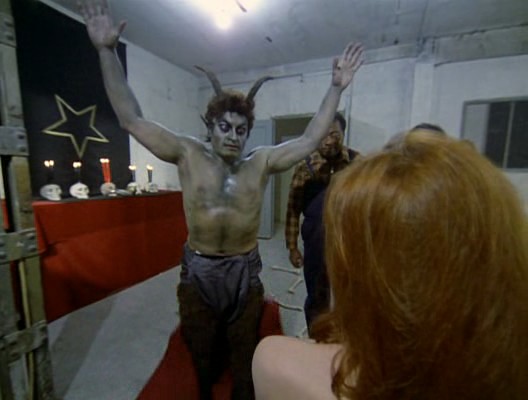
 Paul Naschy, born Jacinto Molina Alvarez, was a musclebound bit player in Spanish films until his breakthrough role in 1968's Nights Of The Werewolf cast him not only as doomed lycanthrope Waldemar Daninsky, but also as a Spansh successor to horror legends Lon Chaney Sr, Boris Karloff and Bela Lugosi. It began a string of genre roles for Naschy throughout the Seventies and early Eighties in which he reinvigorated horror icons such as Count Dracula, the Mummy, Dr Jekyll and many others by drenching them in blood, sex and sadism for a hip, thrillseeking Euro audience. While never a “name” like Christopher Lee in Britain or America, the actor, writer and sometime director was considered a Horror Renaissance Man throughout Europe, who naturally took Naschy to their bloodied and naked bosom.
 Tonight's film, Vengeance Of The Zombies from 1973, sounds suspiciously like yet another European reworking of Night Of The Living Dead, and considering Spain's other contributions to the undead genre at the time – The Living Dead In Manchester Morgue, or Armando de Ossorio's Blind Dead quartet – it's a fair call. Vengeance..., however, reveals Naschy's classical leanings towards the voodoo zombie from the Thirties and Forties – think White Zombie or I Walked With A Zombie. It's the tale of two brothers, both played by Naschy: one a self-styled Indian mystic named Krishna operating out of a remote British country mansion, and his horribly twisted and vengeful twin Kantaka (shhh... just forget I told you that bit!).
  In Naschy's script, there are no George A. Romero style flesheaters, just proposterous white-faced “corpses” in diaphanous burial shrouds. To be honest it's a strange and slightly unsettling mix: an attempt to blend the lyricism of a Forties' Val Lewton chiller will the charnel house demands of a Seventies shocker. So when the shocks come – and trust me, they come in faucets – they tend to seem that much more shocking. However there is an unmistakable style AND charm to Vengeance... in the slow motion shots of the female zombies, the surprisingly graphic Satanic ceremonies, and I suspect the slightly po-faced notion Naschy and director León Klimovsky both held that they were making “art“ rather than a silly and simplistic horror movie. The English dubbing makes Naschy appear a little wooden at times, but there's no denying he cuts a striking figure, either as the swarthy, long-haired
  Naschy continued his career into the Eighties, where both he and the Spanish film industry hit an all-time low. His film appearances, usually in token horror roles, were sporadic, and it was only in the last few years that his career accelerated once more. Sadly Paul Naschy passed away on November 30th 2009 after a long battle with pancreatic cancer. The King of Paella Horror is no more – long live the King, as Schlock Treatment pays tribute to Paul Naschy with the 1973 Vengeance Of The Zombies.