Showing posts with label vampires. Show all posts

Wednesday, December 22, 2010

10th October 2010: The Curse Of The Crying WOman (1963)

The Curse Of The Crying Woman

Mexico 1963 b&w

aka La Maldición De La Llorona

Director Rafael Baledón Writers Rafael Baledón, Fernando Galiana

Cast Rosita Arenas (Amelia), Abel Salazar (Jaime), Rita Macedo (Selma), Carlos López Moctezuma (Juan)


Tonight we revisit the world of Mexican Gothic, a glorious period in Mexico's horror cinema from the late Fifties to early Sixties, after which the intrusion of colour cheapened its brooding black and white aesthetic. Mexico's was an idiosyncratic take on the vintage Universal horrors and the ghoulish terrors of Britain's Hammer films and their European partners-in-crime. One of the truly memorable moments from this brief window in time is the image of La Llorona or the Crying Woman, obsidian eyes blazing and smile like a fatal slash across her cruel white features, holding onto three rabid and almost skeletal hounds straining at their leashes, while her crippled servant Juan dispatches an entire carriage of innocents to their demise. It's the critical point at which Mexican folklore collides with full-tilt Horror, and that moment, along with The Curse Of The Crying Woman's many other iconic snapshots, is breathtaking.


La Llorona the Crying Woman is an old Mexican tale of a peasant woman who gives birth to a rich man's child, only to be spurned for a more acceptable new bride. The woman then kills the baby and commits suicide, leaving her wailing ghost to roam the countryside looking for her lost child. The much-told story is often associated with that of Dona Marina, an Aztec princess who bears the child of Hernan Cortez; the scars of class-bound shame are thus stitched to the deeper wounds of the Spanish invasion and colonization. In other versions, La Llorona is a supernatural predator, a witch who had possibly died during childbirth, and thus feasts on the misery of dying infants.


It's tale often filmed, either as a traditional ghost story, or by exploiting the brand name in a tenuously-linked narrative. In The Curse Of The Crying Woman, the figure of La Llorona is no longer looking for her own child, and is instead an otherworldly superwitch, possessing the souls of her descendants. The spirit is still wailing and quite supernatural to the point of vampiric – her possessed relatives avoid daylight hours, won't cast a reflection, salivate at the sight of blood, and perform the old Bela Lugosi trick of walking straight through cobwebs.


Fate and enduring evil are just two themes at work in The Curse Of The Crying Woman. The young and beautiful Amelia brings her new husband Jaime to meet her long-estranged aunt Selma in her isolated mansion deep in the woods. She discovers Selma looks exactly as she did fifteen years before, is now widowed – or so SHE says – and draped in black, and is deep in research into the Black Arts. So deep, in fact, that she keeps the desiccated corpse of Dona Marina herself, their long-distant relative, stretched on her Aztec torturer's wheel with a long spear through her accursed heart. The malevolent presence Dona Marina is everywhere, from the skulls and black orbs staring out of mirrors, to the wailing of an unseen presence filling the empty hallways. It's no coincidence that Amelia has reunited with her bloodline, as legend has it that Dona Marina makes her triumphant return that midnight. Fatalism descends upon Amelia like a black shroud as she awaits the family curse to unfold; not so Jaime, who has clearly heard of what happens to male members of the Marina clan, and is determined to break the cycle of damnation and death.


Abel Salazar as Jaime is always a welcome face in Mexican horrors, and takes on the producer's reins as he did in The Vampire and The Brainiac. As Aunt Selma, Rita Macedo is perfect at containing her inherent evil and thirst for power behind her beautifully benign mask. The house itself takes on a menacing role, a secluded mausoleum straight out of Poe's Fall Of The House Of Usher, and its ultimate demise is nothing short of spectacular; even the studio-bound forest takes on the ever-present threat of death, as in another snapshot moment of Amelia surrounded by hundreds of eyes staring accusingly from the branches.


All the elements are in place – bloodsucking beauties, bats in the bell tower, the Thing in the attic, and those black, black eyes – for a bona fide masterpiece of Mexican horror. I hope you are suitably unnerved by The Curse Of The Crying Woman.

3rd October 2010: Santo And Blue Demon vs The Monsters (1969)

Santo And Blue Demon vs The Monsters

Mexico 1969 colour

aka Santo y Blue Demon Contra Los Monstruos

Director Gilberto Martínez Solares Writers Rafael García Travesi, Jesús Sotomayor Martínez

Cast Santo El Enmascarado de Plata (himself), Blue Demon (himself), Jorge Rado (Otto Halder), Carlos Ancira (Bruno Halder)


Santo And Blue Demon vs The Monsters is just one of the many successful pairings of masked wrestling superstar Santo and his rival (in the ring at least) Blue Demon. From the late Sixties until Santo's death in the early Eighties, the two seemed almost inseparable, fighting everyone and everyTHING from Dracula, Dr Frankenstein, the mummies of Guanajuarto, fishmen from Atlantis, aliens, Nazis... and in this outing, practically the entire back catalogue of Universal's horror series from the Thirties and Forties. Did someone say “copyright infringement”? Apparently you just stick on a goatee and no-one will notice...


After the necessary tag-team introduction, the film proper begins with the “funeral” of the presumably mad scientist Dr Halder. It's more of an exhumation, as his coffin is hauled back to his castle by a mourning squad of zombie criminals, under the direction of a hunchbacked dwarf in a bowler hat with bald head and bad teeth (luckily for him, the dwarf Waldo has retained his sense of humour). Halder's request for his body not to be mutilated pays off, and he is brought back to life by his own machine in the castle's laboratory by gleeful lever-jockey Waldo. The vinegar-filled Halder has plans to revenge his brother and niece Gloria, for reasons lost to the sands of Time, AND to seek vengeance against his sworn enemy Santo, who just happens to be dating the niece. Halder initially kidnaps Blue Demon and clones him as a robotic assassin to use against Santo, with expected results. Undaunted, he then resurrects a small army of horror icons Halder picked up in his travels through Transylvania: the Vampire, the Mummy, the Wolfman, and The Cyclops, a scaly one eyed amphibian from Sotomayor Pictures' own 1960 picture Ship Of Monsters. Add a pair of vampirized chiquitas and the menagerie is almost complete; oh, and keep your lychees peeled during the laboratory scenes for an unidentified “observer”, also a leftover from Ship Of Monsters, who looks like an angry tiki mug with a brain sombrero.


And so Halder's Chamber of Horrors is unleashed upon the countryside, several times recycling the same introductory footage. The Vampire is less Bela Lugosi and more German Robles as “El Vampiro”, in a pale imitation of Mexico's own horror icon from late Fifties. Frankenstein is more ludicrous than ever thanks to his Fu Manchu facial hair, and as for the Wolfman – well, let's just say the miserably inadequate day-for-night footage makes both El Vampiro and the Wolfman's full-moon antics completely redundant.


If this Santo film looks slightly more cheap and tacky than his usual offerings, send a letter of complaint to Sotomayor Pictures. Both Santo and Blue Demon were on loan to the rival company for a number of films, and so ditched their usual creative team of craftsmen for Gilberto Martinez-Solares, who also directed them in Santo And Blue Demon In The Land Of The Dead. Now, Martinez-Solares was no slouch at directing, but even he must have had a Percodan slipped into his Corona. Did he notice in the restaurant scene, for instance, that the musical number is taking place on a stage FOUR TIMES the size of the entire restaurant? Even the wrestling scenes – obligatory set-pieces in Santo films, and pretty much their raison d'etre – are strangely over-lit and under-attended.


Yes, it's a sloppy production, and one can sense a growing desperation on the producer's part to keep its audience entertained by topping previous outings. The film purports to be a sequel and constantly refers to a previous episode, and yet there IS original; the effect is like being thrown into the deep end of a swamp and wondering “who ARE these creatures, and why do they want to kill me?” The thought is then replaced with a screaming case of deja-vu. Santo and Blue Demon complement each other well, even if Blue Demon spends most of the film trying to tear his friend's head off; but their partnership was becoming increasingly part of a cookie-cutter formula of multiple wrestlers battling pre-branded “monstruos”. The trade-off is quantity over quality, and Santo And Blue Demon vs The Monsters is almost bursting its stitches with ideas, both good and awful.


On the plus side it's punchier than Santo's ring buddies, zips along at an unnatural pace, and for a film aimed at twelve year olds of all ages, surprisingly bloody – there are some graphic shots of a young man's face being crushed under Frankenstein's giant boot, and the vampire girls are dispatched with a steady flow of the red, red vino. The switch to colour in the late Sixties wasn't all wine and rosaries, however, and in the faces of Walder's zombies you can see where the green paint finishes.


Keen-eyed Schlock watchers please note: Frankenstein is played by stuntman Manuel Leal, later in wrestling tights as Tinieblas, and our lovable hunchbacked dwarf, one of the busiest Little Guys in Mexican cinema named Santanon, is the guy in the plushy suit in Puss In Boots (1961) in three weeks' time. Til then: hola hola rock y rolla, Santo y Blue Demon Contra Los Monstruos!

Monday, September 6, 2010

5th September 2010: The Satanic Rites Of Dracula (1973)

The Satanic Rites Of Dracula

UK 1973 colour

aka Count Dracula And His Vampire Bride, Dracula Is Dead... And Well And Living In London

Director Alan Gibson Writer Don Houghton

Cast Christopher Lee (Count Dracula), Peter Cushing (Professor Lorrimer Van Helsing), Michael Coles (Inspector Murray), William Franklyn (Torrence), Freddie Jones (Professor Julian Keeley), Joanna Lumley (Jessica Van Helsing)


Tonight is the first in a four week season of British genre chillers, starting with Christopher Lee sucking his way through the Swinging Seventies in The Satanic Rites Of Dracula.


The name Hammer Films is virtually synonymous with British horror: a production house dating back to the Thirties who changed the face of horror cinema in the late Fifties with a pair of gory, colour-soaked reworkings of Frankenstein and Dracula. They were stylish and straight-faced, unlike the gleefully dumb horror pictures of the American drive-ins, with equal amounts of ghoulishness and restraint. The next Golden Age of Gothic Horror was about to begin, and Hammer led the pack for the next fifteen years, its Frankenstein series starring Peter Cushing as the Baron, and its Dracula films starring Christopher Lee with an occasional visit by Cushing as Van Helsing, book-ending its tenure.


Cushing and Lee WERE British horror until Hammer's gradual decline in the mid Seventies, and Christopher Lee was easily the most recognizable Dracula of his generation. Still, Hammer were forced to swing with the times, and dragged the Count kicking and screaming into the Seventies with an ill-advised Carnaby Street makeover. The result, Dracula AD 1972 (1972), brought Dracula to hipsters grooving on the occult, the Psychedelic Generation and the Permissive Society, but was neither hip nor horrific, and even the venerable presence of both Christopher Lee and Peter Cushing as the descendant of Dracula's arch-nemesis Professor Van Helsing could save it.


It seems bizarre that Hammer would give director Alan Gibson and writer Don Houghton a second shot at a contemporary Dracula sequel, and yet here it is: The Satanic Rites Of Dracula, set two years later, opens with an undercover agent infiltrating an updated version of the Hellfire Club. With his dying breaths he tells his aghast superiors tales of occult rituals and human sacrifice in the presence of government officials, the military and the country's top biochemist. Is it just harmless kicks for jaded power junkies, they ask Professor Van Helsing? Is it the Red Chinese, or something much darker? The trail of Hellfire leads Van Helsing to reclusive industrialist DD Denham, his multi-story mausoleum build on the final resting place of Dracula two years earlier, and to reveal his true identity and his diabolical Final Solution.


The Satanic Rites Of Dracula would be the swan song in Hammer's fifteen-year series, and some would call it a sad coda for a once-great franchise. I for one find it a fascinating latter-day Hammer horror, a melding of familiar gothic motifs with a conspiracy thriller, its cold modernism captured in unnerving wide lenses and overcast with a real apocalyptic menace and Christopher Lee's shadow of timeless evil. Its flaws are many and glaring: there are simply too many protagonists vying for screen time, some welcome – the lovely Joanna Lumley as Van Helsing's granddaughter Jessica has perhaps the film's finest moment amongst a basement of amorous female vampires – some less welcome, and some, like the commanding presence of Christopher Lee in the title role, criminally underused.


In the same year British horror was under attack on multiple fronts – from the European sex-and-blood shockers to the spiraling gore of American drive-ins, to Warners releasing The Exorcist, the most expensive B film ever – the comparatively anaemic Satanic Rites... could never compete, lacking many of the essential Bs: blood, breasts, and budget. Let's hope the colder, infinitely more evil 21st Century will be kinder to it. Time to go into the basement and unleash the vampire brides for The Satanic Rites Of Dracula.

Monday, December 28, 2009

Sunday 27th December 2009: Boy God!

Boy God

Philippines 1982 colour

aka Stone Boy, Rocco Ang Batang Bato

Director J. Erastheo Navoa Writer Joeben Miraflor

Cast Nino Muhlach (Rocco), “Jim Melendrez”/Jimi Melendez, Isabel Rivas, Cecille Castillo, Dely Atay-Atayan (Granny), Jimmy Wilson (Mengele), Palito (Pancho)


Hola, Schlockmongers, and welcome to a family holiday edition of Schlock Treatment. It's that time of the year for an insane kiddie flick, and tonight's movie from the Philippines more than qualifies. Many of these shot-in-Tagalog fantasy films were never destined to leave the Philippines; thanks to busy distributor Cinex Films, we have this demented miniature Clash Of The Titans, which frankly gave ME nightmares as a kid, along with its other galleries of provincial grotesqueries.


Boy God, or Stone Boy as it's also known, stars possibly the most famous Filipino child star of all time, Nino Muhlach. Success for young Nino was in his genes, as the Muchlach clan was tantamount to film royalty - Auntie Amalia Fuentes (The Blood Drinkers [1964] and Curse Of The Vampires [1966]) will be forever remembered as the "Elizabeth Taylor of the Philippines". From age three, Nino would receive top-billing with the most famous film stars of the Seventies, and sentimental audiences warmed to his moon face and chubby thighs immediately, so that one of his 1977 films would out-gross the original Star Wars. Nino's father Alexander Muhlach formed D'Wonder Films to capitalize on Nino's early success, thus becoming one of the most powerful independent producers of the day.


By 1982 he was approaching his teen years and was now not so cute and adorable, and his box office lustre had begun to lose much of its shine. D'Wonder had previously bought into the iconic Darna franchise with Darna At Ding, featuring Vilma Santos as the Philippines' answer to both Supergirl and Wonder Woman and cherubic Nino as her little brother, and with its already-established Darna fanbase and cheap yet charming and effective special effects, the film broke box office records as the most successful Darna ever over Christmas 1980. The Muhlachs wisely decided to return to the fantasy genre one more time with 1982's Boy God.


Baby Rocco is born the same night his parents are gunned down outside their house. Years later, Rocco is now a precocious eleven year old living with his grandmother, who warns him to keep his growing powers secret. “You’re like limestone,” she explains - harder under heat, but dissolves in water. Just what a self-conscious 12 year old wants to hear. Meanwhile the evil German scientist Dr Mengele is turning the village into werewolves and vampires, and the pale bodies of their victims are starting to pile up by the waterfront. Little Rocco is captured by three witches who keep him weak and moist and, in the film's most disturbing image of all, they tie a naked, basted Nino to a bamboo spit under a full moon (not Rocco’s, of course) while turning into werewolves. The heat naturally makes him stronger and he escapes, only to be picked up in a fantastic tracking shot by a swooping, screeching vampire bat (a costume with enormous bat ears and umbrellas for arms).


Recovering in a cave, Rocco sees a vision of Vulcan, an Elder of the Immortals. The blind coot tells Rocco of his Immortal heritage - his father, Python, fell in love with a mortal, making him half-god - and suggests he travel to the Land of the Small People to save his parents from Limbo. At this moment the film morphs once again from vampires and werewolves and becomes Clash Of The Titans, or a much cheaper Italian variety sword and sandal adventure. He wakes next to a gladiator costume ("looks like a fat girl's dress!") and sets off towards his mist-shrouded goal, battling a small array of mythical creatures, but aided by an army of dwarves - all no taller than Rocco - and the girl warrior “Janus”, who looks and sounds suspiciously like Darna. Cue the trick perspective shots and claymation that would make Ray Harryhausen blanch, and perhaps the definitive shot of the film, in which the giant cyclops Golem plucks up one of the dwarves, chomps through his middle (this is a kid’s film?) and spits out his sword like a toothpick.


It's a strange film alright, cute and baffling, though with a simple three-act structure - boy learns powers, boy battles monsters, boy becomes immortal - which never allows the film to grow stale. Filipino films are renowned for "borrowing" elements from other films, and it's not just Clash Of The Titans from which the film takes its cues; there's the dwarf army from Time Bandits, and a lycanthrope transformation scene cribbed from either An American Werewolf In London or The Howling which, despite its crude stop-motion effects with plasticine and Brillo pads, is unnerving enough both in its primitivism, and in its family film context. There are also echoes of the Philippines' own bloodthirsty folklore in Boy God's creatures: shape-shifting female blood drinkers, the Aswang, and the bat-winged eaters of the dead, the Manananggal (unlike Boy God's batmen, however, their torsos detach themselves for easier flying), which have been unnerving Filipino children, not to mention adults, for centuries. It's this black wedding of Hollywood fantasy and horror and the Philippines' own brand of ghoulishness which gives Boy God its potency - a Harryhausen epic on a hundredth its budget, of course, but with monsters the folk in the Provinces will tell you are very, VERY real. Now that's unnerving.


Still, unnerving audiences is our speciality, and Schlock treatment is proud to bring you our gory, certifiable Holiday Special: the 1982 Boy God.

Thursday, August 28, 2008

30th August 2008: Santo vs Frankenstein the Mexican Vampire!

Santo And Blue Demon vs Dr Frankenstein


Mexico 1974 colour


aka Santo y Blue Demon Contra El Doctor Frankenstein, Santo y Blue Demon Contra El Doctor Frankestein


Director Miguel M. Delgado Writers Francisco Cavazos, Alfredo Salazar


Cast Santo (himself), Blue Demon (himself), Sasha Montenegro (Alicia Robles), Jorge Russek (Dr. Irving Frankenstein), Ivonne Govea (Marta), Carlos Suárez (Henchman), Rubén Aguirre (Dr. Genaro Molina), Jorge Casanova (Dr. Mora)


Hola, bastardos, and welcome to yet another Mexican wrestling/horror double bill here on Schlock Treatment. After the break is the return of the German Robles in The Vampire’s Coffin, but first is a masked wrestling horror with a villain so dastardly it takes two masked wrestling superheroes to battle him: in Santo And Blue Demon vs Dr Frankenstein.


Our Man in the Silver Mask had already met the entire set of Universal Monsters in previous outings, including the Frankenstein monster in Santo And Blue Demon vs The Monsters (1970) AND the prodigy herself in Santo vs Frankenstein’s Daughter (1972). The producers decided it was time to meet the great man himself, and in 1974 paired long-time wrestling compadres Santo and Blue Demon against a very hip Dr Irving Frankenstein. He claims to be 113 years old yet he’s kept up with fashions – pimped out in a jacket and pink shirt, he looks more like a club owner than scientist. And, armed with an anti-aging formula most grizzled old scientists would kill to get their claws on, he plans on perfecting his brain transplant operations to resurrect his bride, stored on ice for the last 80 years.


All work and no hoy-hoy has made Frankenstein a very unstable sociopath indeed. The slew of missing girls end up dead on his operating table, but he’s fine with that; he’s just that bit closer in his experiments. Then, to rub salt in society’s wounds, he reanimates their bodies and sends them back home – like homing corpses! Frankenstein does have one successful experiment, however, and he plans to transplant Santo’s brain into “Mortis”, his radio-controlled seven foot Golem, by kidnapping Santo’s would-be girlfriend Alicia and holding him to ransom. Part of the hairbrained scheme involves a wrestling match between Santo and Mortis, with Frankenstein as his masked manager! Propped up by the nutty Professor Ruiz and a pair of undercover cupcakes, this is just one of three Santo matches, in their extended three-round glory – indulgent, to be sure, but the Mexican audiences would be falling off their seats as readily as the studio-bound crowd, while the announcer almost swallows his microphone screaming choruses of “Aye aye aye!”


This preposterous latter-day Santo adventure is as colourful as its hideous Seventies décor, with an eccentric jazz and lounge score completely at odds with the onscreen action. Lucha Libre purists prefer the classic black and white period over the increasingly silly colour films, in which atmosphere and a modicum of subtlety are traded in for rubber masks, flared collars and cheap yuks. Well, I say “pish” and “pah!” as well unfold a very entertaining chapter in the annals of Mexican masked wrestling horror cinema: Santo And Blue Demon vs Dr Frankenstein.


The Vampire’s Coffin


Mexico 1958 b&w


aka El Ataúd del Vampiro


Director Fernando Méndez Writers Ramón Obón, Raúl Zenteno


Cast Abel Salazar (Dr. “Henry Hetherford”/Enrique Saldívar), Ariadna Welter (“Martha”/Marta González), Germán Robles (Count Karol de Lavud), Yeire Beirute (“Manson”/Baraza), Alicia Montoya (María Teresa), Guillermo Orea, Carlos Ancira (Dr. Marion)


A few months ago we screened the classic 1957 Mexican horror film The Vampire, a wonderfully atmospheric Hispanic variation on the old Universal Dracula films that even beat Hammer’s hugely influential The Horror Of Dracula by a year. In Mexico The Vampire was a smash as well, prompting the producer/star Abel Salazar to crank out a sequel post-haste, and the result, 1958’s The Vampire’s Coffin, is thankfully more than just an opportunistic, by-the-numbers rehash of the original.


In The Vampire, Salazar plays Dr Henry, an undercover vampire hunter on the trail of European count Lavud (essayed with effortless aplomb by Mexico’s own Christopher Lee, German Robles), now comfortably entrenched in a Mexican hacienda with one eye on resurrecting his dead vampire brother, and the other on local beauty Martha (played by Ariadna Welter), whom he plans to make his vampiric bride for all eternity. Naturally Lavud is dispatched with a stake through his heart, Henry and Martha disappear into the sunset arm in arm, and all appears right with the world. Which, we all know, is disastrous for a potential sequel – time for us stupid humans to screw things up.


The Vampire’s Coffin opens with Dr Henry and Martha both working and both still flirting with each other in a nearby hospital. Hearing of the legend of Count Lavud, Henry’s colleague Dr Marion pays Manson, a predatory body snatcher, to steal Lavud’s coffin so he can unravel the scientific mysteries of vampirism first hand and strip back superstition - literally - to its bare bones. Manson has other ideas, however, and returns for Lavud’s clasp, draws out the stake, and is now a willing slave to his vampire master. Naturally Lavud heads straight for Martha to fulfil the promise in the first film, who he claims history has marked as his betrothed. Henry, meanwhile, has to explain to the hospital director he’s lost a cadaver AND a vampire in the one casket.


What could have been an crass and utterly unnecessary sequel thankfully expands on The Vampire, taking the action out of its village setting to a hospital, and then to the memorable finale cutting between an elaborate theatre set and a waxworks museum filled with instruments of death and torture. German Robles as Count Lavud is as coldly aristocratic as ever, but like Christopher Lee in Hammer’s Dracula sequels, is given less to do, and without the first film’s character development is in danger of becoming a one-dimensional bogeyman. It’s only a minor sticking point, as is the usually meticulous dubbing from American distributor K Gordon Murray which here borders on Hercules Returns. Ultimately it’s a fine sequel, not in the “classic” status of the original but in the hands of Salazar, Robles and co, an enjoyable romp of a Hispanic horror flick: it’s time to crack open the 1958 The Vampire’s Coffin.

Monday, July 14, 2008

18th July 2008: Santo Attacks!

Santo And Blue Demon vs Dracula And The Wolf Man

Mexico 1972 colour

aka Santo y Blue Demon vs. Drácula y El Hombre Lobo

Director Miguel M. Delgado Writer Alfredo Salazar

Cast Santo (himself), Blue Demon (himself), Aldo Monti (Count Dracula), Agustín Martínez Solares [hijo] (Rufus Rex, the Wolf Man), María Eugenia San Martín (Laura Cristaldi), Wally Barron (Eric), Jorge Mondragón (Prof. Luis Cristaldi)

Greetings everyone, and welcome to yet another trip down Mexico way. We've seen a great many Santo adventures here on Schlock Treatment so I won't reiterate the Lucha Libre story. Those familiar with Santo's movies will no doubt recognize a certain element of recycling going on - familiar themes, characters, and so forth. Then there's what Bollywood calls "masala" filmmaking: throw everything you have into the curry and see what sticks. Santo teamed up with fellow wrestler has worked before? Drag him back. THEN pit them up with brand-name horror characters - not one, but TWO of them. ¡Muy bien! And so, luchadores and luchadoras, we are in for what could be the greatest wrestling tag match in film history: Santo and Blue Demon versus Dracula and The Wolf Man!

In Santo And Blue Demon…, Santo is dragged into a supernatural mystery by his (much younger) girlfriend Lina, whose uncle Professor Castaldi has received some ominous news. His wizard ancestor had dispatched Dracula and the Wolf Man to oblivion some 400 years before, but according to a letter he's received, the time is nigh for their resurrection. A slovenly hunchback named Eric, it seems, has been perched on the two coffins for years waiting for them to hatch. Kidnapping the Professor, he slits his throat - Hammer's Dracula Prince Of Darkness style - and brings the two ghouls back to life to start up their plans for world domination once more. Step one: create an army of vampires. Step two: create a werewolf army. Step three: Revenge time on the three remaining Castaldi girls. The FIENDS! Both are working for their infernal master Satan who sadly never makes an appearance, but in whose name the planned mating of vampires and werewolves will take place. Sounds like Underworld, I realize, but without Kate Beckinsdale, and this certainly works in their favour.

Dracula, played by Italian actor Aldo Monti who also played the same role in the 1967 Santo In The Treasure Of Dracula, tries every trick to bring the girls via hypnosis, but is either thwarted by the Professor's lucky dagger, or by the freakish intuition of Santo himself. Time for the Wolf Man, now going by the less-conspicuous name Rufus Rex, to shave the nose and eyelids and seduce the Professor's widowed daughter Laura. She thinks he's handsome; with Rufus' skinned sheep expression, obviously standards have changed, or hers were in the doghouse all along. For someone who's four hundred years old he took to Seventies fashion (and specifically a bile-inducing lemon silk shirt) really quickly. ""I never thought I could be happy again," she moans, running her fingers through Rufus' greasy locks. Cue howling sounds - howls of derision from the Trash couch!
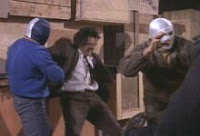
Santo feels he's somehow outnumbered and turns to his old wrestling buddy Blue Demon for assistance. True to formula, our heroes get one wrestling match each: Santo squares off against the eye-popping Angel Blanco - "he's a nazi in the ring!" - while in a separate match Blue Demon takes on the ingeniously-dubbed Renato the Hippie (of course he's a bad guy - look at the shaggy hair and fur pants! HE'S A HIPPIE!"). Both bad guys have their own bags of dirty tricks, prompting the announcer to scream "Rudos! Barbarians!" and you too will be screaming at the screen protesting against the injustice of it all. All of which sets up the final tag team match in the basement full of spikes, with Santo and Blue Demon working like a well-oiled machine against a veritable army of werewolves, vampires and zombies. Again, just like Underworld. Which begs me to ask the age-old question: what is the difference between Kate Beckinsdale and the American flag? It would be wrong to urinate on the American flag.

Being a Seventies Santo film it's in colour, and yet surprisingly isn't as ghastly-looking as many coloured Santos - the Seventies scheme of browns and blues actually work together rather than set your teeth on edge. It could be one of the most entertaining of all Santo adventures, and not only for its outrageous conceit: Santo And Blue Demon vs Dracula And The Wolf Man zips along at a ripping if a tad predictable pace, oiled with sheer balls and genre juice. Masala filmmaking - or whatever the Mexican equivalent - it may be, but no doubt you'll be cheering for Santo AND Blue Demon like a hopped-up frijito as they take on Dracula and the Wolfman. Viva!

Santo Attacks The Witches

Mexico 1964 b&w

aka Atacan Las Brujas

Director José Díaz Morales Writers Rafael García Travesí, Fernando Osés

Cast Santo (himself), Lorena Velázquez (Elisa/Mayra), María Eugenia San Martín (Ofelia), Ramón Bugarini (Arturo), Edaena Ruiz (Medusa)

Cut to 1964 and a much earlier chapter in the Santo saga, brought to you by Corona and Bacardi Rum - or so it appears from the banners in the wrestling ring! Santo Attacks The Witches opens with an elaborate pre-credits dream sequence, in which a young woman Ofelia is suffering from nightmares, deliriously believing her family's hacienda is somehow evil and overrrun by black masked figures surrounding a figure resembling Satan named the Lord of Shadows. She also dreams of being rescued by a man in a silver mask and cape. Oh no, she's told, that man actually exists. And, true to her vision, her still-youthful aunt Elisa (Lorena Velazquez) is actually the centuries-old witch Mayra, who along with her stunning, diaphanous Handmaidens of Darkness, plans to sacrifice both Ofelia and Santo to the Great Horned One.

Atacan… was originally shown in three half-hour chapters, which explains its choppy, episodic nature and cliffhanger structure: fight, capture, escape, fight, capture... At first Santo is set upon by the three anonymous black clad henchmen (who are in fact three wrestling identities: Fernando Osés, Crox Alvarado and El Lobo Negro) doing acrobatics through the flimsily effective sets before being defeated by Santo forming a crucifix with his outstretched arms. In a word: GENIUS. Next phase is to kidnap Ofelia's fiancee Arturo, and for Mayra's seductive sidekick Medusa to tempt Santo by wandering around in her stripper underwear in front of him waving her talon-like fingernails. "All of this is absurd," mutters Santo. "And you too." Never have truer words been spoken by a masked wrestling superhero in a cape.

Ubiquitous actress Lorena Velasquez was comfortable playing all roles, as her tenure as one of the Wrestling Women or Luchadoras will attest, but I prefer her in villainous roles, such as the bloodsucker queen in the earlier Santo vs The Vampire Women, which this film is clearly a reworking. Aside from the plundering of Velazquez, the rest of the "witches" - those who avoid the sun and crucufixes and turn into rubber bats - are merely Vampire Women in disguise, and aren't fooling anyone. Filmed back-to-back with The Diabolical Axe in 1964 for a smaller company, it's clear these second-rate scheisters are exploiting the success of earlier Santo adventures, wringing every drop of donkey juice out of this well-squeezed burro. While it's certainly not the greatest Santo we've screened, there's a lot to recommend: startling visuals, a fantastic theremin-laced soundtrack and gorgeous b&w photography, partly paid for by Bacardi and Corona. Remember this, consumers: the power of advertising compels you, even forty four years after the event, when Santo Atacan Las Brujas, or Santo Attacks The Witches.

Saturday, March 8, 2008

11th April 2008: Santo vs the Monster Crusher double!

Santo vs Dr Death

Spain/Mexico 1973 colour

aka Santo Contra El Dr Muerte; onscreen title "Masked Man Strikes Again (Santo vs. the Dr. Death)"

Director Rafael Romero Marchant Writers Rafael Romero Marchant, José Luis Navarro Basso

Cast Santo (himself), Carlos Romero Marchant (Paul), Helga Liné (Sara), Jorge Rigaud (Dr. Robert Mann)

We continue our season of Santo films with the fourth and final Santo film dubbed into English. I sometimes forget just how far these Mexican wrestling films travelled - even as far as Turkey, where they stole the Man in The Silver Mask's image and teamed him up with Captain America against an evil Spiderman.

Naturally the Spanish-language Santo films would be a huge hit in Spain, and not just because of the lingo; Spain, like the rest of Europe, was obsessed with comic book superheroes, and in numerous co-productions with Italy they made their own: Goldface, Argoman, Superargo, the list is seemingly endless. Enter Santo vs Dr Death, a Mexican masked wrestling film which was actually made in Spain by an all-Spanish crew by Santo's European distributor. Its bizarre pedigree thus makes it more like a crazed Euro-trash mélange of spy, crime and science fiction motifs than its familiar Mexican configuration. Of course I say "Euro-Trash" with the utmost respect.

Our mask-wearing, villain-wrestling, crime-fighting superhero Santo heads to Madrid for an intercontinental championship, where he is asked by Interpol to investigate the vandalism of a priceless work of art. The acid-scarred painting is handed over to art expert Doctor Mann to do a restoration job, but Interpol suspect a possible forgery factory at work. Santo takes his new assistant, a chain-smoking jailbird named Paul who knows the local curves, to Dr Mann's castle to investigate: all they find is the good Doctor (of art AND chemistry, no less), his overly-made up assistant Sara (played by Spanish horror regular Helga Liné), and a pool dotted with gorgeous life models having fun in the sun. Santo is still not convinced, and sends in a curvy female Interpol agent undercover and finds that, despite the fact the original Mona Lisa is hanging in his bedroom, our Doctor Death is more of a Bondian villain than a top-shelf art thief. His castle is equipped with secret dungeons, laboratories, booby traps, and a series of ghastly experiments ending up in a huge vat of acid. "You're crazy!" screams one of his models. "That's possible," replies Dr Mann. "But my insanity is sublime."

Santo Contra el Dr Muerte is unfairly dismissed by many Santo fans as "too Seventies", but therein lies its charm: an intensely and perversely Seventies aesthetic, with a James Bond soundtrack gone surfadelic almost to the point of cheesadelic, and the absurd image of a masked wrestler (a man pushing sixty, no less) swinging from a helicopter in a classic speedboat chase. Schlock Treatment, as always, is proud to present another in our Fiesta del Santo: the 1973 Santo vs Dr Death.

The Curse Of Nostradamus

Mexico 1959/1961 b&w

aka La Maldicion de Nostradamus

Director "Frederick"/Federico Curiel Producer Victor Parra Writers Alfredo Ruanova, "Charles E. Taboada"/Carlos Enrique Taboda

Cast German Robles (Nostradamus), Domingo Soler (Professor Dolan), Julio Aleman (Antonio/Tony), Aurora Alvarado (Anna), Manuel "Manver/Mamber" Vergara (Leo), Grek Martin (Igor)

We've played some strange Mexican horror films over the last year - The Brainiac springs screaming and slurping to mind - but none as abstract as The Curse Of Nostradamus. What started its life as a twelve part serial for Mexican theatres in 1959 was edited into four features between 1961 and 1963; in the great South of the Border gold rush, it was bought by Florida distributor K. Gordon Murray along with a mountain of other Mex-horrors, redubbed, repackaged and sold to American TV in the mid Sixties. The Curse Of Nostradamus is the first three episodes, which explains its fragmentary nature, and why it conveniently builds to a cliffhanger duel between the forces of good and “evil”.

And what a bizarre character representing the “dark” side: played by the tall, gaunt, aristocratic German Robles, a distinguished poet and stage actor forever typecast in similar roles after the phenomenal success of his title role in The Vampire and The Vampire's Coffin. With Nostradamus Junior his El Vampiro persona veers off on a wild tangent: a surrealist anti-hero with one foot in the world of shadows, taunting the pitiful mortals with his accursed knowledge in such erudite fashion.

The Sixteenth Century occultist prophet Nostradamus is now the living dead, resting in a coffin in his Aztec-style castle and issuing orders to his vampire son to destroy the wave of rationalist science sweeping over the land and restore the good family name. The son (let’s call him Nostradamus for convenience) gatecrashes the engagement party Professor Dolan is holding for his daughter Anna and her fiancée Tony, who is also the Professor's assistant). Dolan foolishly dismisses rumours of vampires, having just finished a series of lectures on the need for a scientific and rationalist approach on all superstitions. In swoops Nostradamus, in top hat and cape, hypnotically wide-eyed and utterly humourless. He demands Dolan acknowledge the World of Shadows, and to underline the point, begins to works his way, serial killer style, through a shit list of the Professor’s thirteen dinner guests like a satanic Steve Buscemi. Naturally the Professor is forced to rethink his ideas on the supernatural while predicting Nostradamus' next move – which is difficult, considering Nostradamus can turn into a bat at will, and dispatches his hunchbacked assistant (who sounds suspiciously like John Hurt as the Elephant Man) as muscle.

It’s as insane as it sounds, wet with lurid horror imagery from Fifties comic books and 40s horror films filtered through a unique genre-obsessed culture of colonialism, Catholicism, Hispanic fervour, and European philosophy. It's a deliberate effort to reinvent both the already-haggard vampire mythos and German Robles himself into Mexico's finest character actor; unfortunately for Robles, the public could never see beyond the film's pulp origins and he was doomed to remain, in their eyes at least, locked in the horror graveyard. For all its pseudo-intellectual posturing and pretensions as high-brow art, it’s still an enjoyably dumb (though wordy) Mexican horrorshow: the first in a four part cliffhanger series starring the utterly unique figure of a serial-killing vampire philosopher, the 1959/1961/1965 Curse Of Nostradamus.