The Wild World Of Batwoman
USA 1966 b&w
aka She Was A Hippie Vampire
Director/Writer Jerry Warren
Cast Katherine Victor (Batwoman), George “Andre”/Mitchell (Professor G. Octavius Neon), Steve Brodie (Jim Flanagan), Richard Banks (Rat Fink), Bruno VeSota (Seltzer)
 Here at Schlock Treatment we've championed the films of Z auteurs such as Ed Wood Jr, Ray Dennis Steckler, Larry Buchanan and many others. Mostly they were enthusiasts who truly wanted to make a good film, but ultimately didn't know how; it's their shared passion and inherent naivety that gives the films their charm. Then there's Jerry Warren, a contemptuous character whose disregard for his audience is legendary. It's often said he knew exactly what his audience wanted - he just refused to deliver.
 Warren operated as an almost one-man production unit and distributor from the mid Fifties on and off until his last film, 1982's Frankenstein Island. His productions were primarily patch-up jobs, buying monster movies on the cheap mostly from Mexico but also Sweden and, for some strange reason, Panama. Unlike the other king of the Mexican redux K. Gordon Murray, Warren refused to dub them, instead shooting wrap-around footage with American actors, sometimes in static shots taking up an entire 10 minute can of film, to explain the action. This, in itself, is so much more complicated than simple dubbing, but it bumped off the original authors so the credits read "directed by Jerry Warren". Herein lies a key to understanding Warren's bizarre film universe: his compulsion to churn out films, no matter how appalling the finished product was.
 Then there's the films he made from scratch, in a rare fit of inspiration. The Wild World Of Batwoman from 1966 was an obvious cash-in on the Batman craze, but with the texture and self-conscious unfunniness of a Sixties porno. It's such a grotesquely painful act of self-sabotage that it begs the question: who was it made for, and why?
 Veteran Warrenite Katherine Victor, best remembered as mad scientist in his 1960 Teenage Zombies, is the title character. Obviously a little long in the fangs to play "Batgirl", the wary Victor was lured back to Warren's stock company with the promise of a spectacular Batboat and outfit, none of which Warren could or would deliver. Instead she cobbled together her own costume with a black teddy, feathered mask, bondage boots and a Bat Tattoo across her cleavage in eyeliner. Needless to say, she is a magnificent creature.
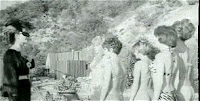 The plot, for what it's worth, features Batwoman and her Batsquad of Batgirls on the trail of a missing Atomic Hearing Aid, stolen from the Ayjax Development Corporation. Now in the hands of her Arch nemesis Rat Fink (yes, you heard correctly), he blackmails Batwoman into helping him take over the world. Meanwhile Rat Fink's insane brain trust, the Dr Strangelove-esque Professor Neon and his hunchback assistant Heathcliffe (hear that? It's Emily Bronte clawing at her coffin lid!) plan to mate the captured Batgirls with his patented monsters (and yes, that's footage from The Mole People) in Rat Fink's underground city. The film's idiotic denouement is little more than an excuse for an umpteenth scene of go-go dancing on the beach, and if the one-dimensional Batgirls redefine the term "amateur theatrics", keep in mind the local strip club was being closed down by the police while Warren's casting director waited outside with a huge butterfly net.
 It's like a porno without porn, a joke without a punchline, a Batman episode stretched to the point where Victor Buono's stripped naked and crying into his icecream. Of course, DC comics sued; Warren merely changed the name to She Was A Hippy Vampire and shot an opening scene of brand new go-go girls quaffing blood to turn them into Batwoman's loyal bloodsuckers - but of the synthetic kind, of course. "Mint, cherry, strawberry yoghurt," they list mindlessly. "It's a GROOVE!" Naturally, vampires are never mentioned from this moment onwards.
It's a crime, to be sure, and since Warren is no longer with us, I'm sure he's doing his penance in one of the outer rings of Hell. Ironically, just as Warren was compelled to make terrible films, we are compelled to watch them, and just like the strip club bunnies on happy pills who can't stop dancing, we'll still be there at the end of the film doing the monkey. "I don't want another pill!" one screams. "I'm tired of being happy!" Just keep dancing, honey, to Jerry warren's hypnotic Go-Go beat of the mad, bad, Wild World Of Batwoman.
 Turkish Star Wars
Turkey 1982 colour
aka Dünyayi Kurtaran Adam/“The Man Who Saved the World”
Director Çetin Inanç Writer Cüneyt Arkin
Cast Cüneyt Arkin (Murat), Aytekin Akkaya (Ali), Füsun Uçar (Bilgin'in Kizi), Hüseyin Peyda (Bilgin)
 There's a scene missing from Star Wars Episode IV that no doubt ended up on the cutting room floor, in which Turkey's busiest actor Cuneyt Arkin puts a gun to Chewbacca's head and says, "Fly this crate to Istanbul." That footage may be long since destroyed, but we still have evidence of one of the greatest film high-jackings of all time: The Man Who Saved The World, or more affectionately known as the Turkish Star Wars.
 In the annals of Third World film thievery, Turkey is the Pirate King: witness the Turkish Tarzan, ET, The Wizard of Oz, Captain America & Santo vs Spiderman, Exorcist, Superman, Star Trek, and even the Turkish Young Frankenstein. They all come from a film industry known as Yesilcam, the Turkish version of Bollywood which, from the late Fifties until its peak in the early Seventies, was cranking out up to 300 films a year. That's a staggering amount, considering most were never shown beyond the Turkish borders. And that's just as well - many films were deliberate carbon copies of Hollywood hits, often with stolen music and occasionally with stolen footage - in legal terms, "mimicry beyond innocent inspiration". Either Turkey didn't buy into international copyright laws, like the Philippines, or didn't believe their films would EVER appear on Hollywood's radar.
 By the late Seventies, Yesilcam was in its decline due to colour film's increased cost of production, serious competition from Hollywood, political and economic turbulence, and of course the proliferation of TV. The Man Who Saved The World (1982) was regarded as Yesilcam's Last Stand, a final assault on Hollywood hegemony with all guns blazing, and armed with sheer chutzpah, a flagrant disregard for the rules of international copyright, and a tin shed full of the most randomly selected costumes. For a country where stealing from Hollywood is second nature, the Turkish appropriation of Star Wars is their most ambitious hijacking of all.
 The film opens with our two Turkish heroes Murat and Ali battling the enemy of mankind, a Darth Vader clone in a spiked helmet known as The Wizard, against a stretched backdrop of George Lucas' destruction of the Death Star. And listen carefully - is that the theme to Raiders Of The Lost Ark? It won't be the last time your ears pick up the familiar strains of American pop culture; from Planet Of The Apes to Moonraker, The Black Hole to Battlestar Galactica, they're all represented in a rare case of Equal Opportunity Thievery.
 Our heroes' X-Wings (ahem) crash land on a planet - ostensibly an alien one, although, under the shadow of Planet Of The Apes they see Egypt's Pyramids and the Sphynx - but a planet nevertheless with humanoids, the last survivors of a race wiped out by nuclear war. Captured by an army of horse-riding skeletons (it's not as cool as you'd imagine). Murat and Ali are rounded up with the remaining human population to be farmed for blood to keep the aging Wizard alive. Those drained become instant mummies in the Wizard's army, but not our heroes: they leap into an extended training sequence, even as far as strapping huge boulders to their legs (I wonder what they resemble, kids?) before embarking on a quest for a plywood sword and a pulsing green brain and thus rescue the Earth before the film's finale.
 And WHAT a finale - a bloodied tinpot spectacle with gorilla suits, exploding heads, X-wings destroying the Death Star, and shots of Lucas' stormtroopers intercut with Cuynet karate-chopping red fluro plushies in two with his metal hands. I guarantee you have never seen a film so incongruous, so jaw-dropping, so overwhelmingly and consciously blatant in taking on Hollywood at its own game: 1982's The Man Who Saved The World, occasionally known as the Ottoman Empire Strikes Back, or The Turkish Star Wars.


 Welcome to Instanbul in the 1970s, where men roamed the streets in flares and regulation mutton chops and mustaches, smoking was regarded as one of the erotic arts, and popular culture is fair game - even masked wrestlers from Mexico City couldn't walk the streets without encountering Turkish film producers with large rolls of flypaper trying to snare a costumed superhero or two. In the case of tonight's movie, they found three - and possibly more - in the baffling "Three Mighty Men", or as we prefer to call it, The Turkish Santo and Captain America vs Spiderman.
 Long-time Schlock Treatment viewers will recognize the term "Turksploitation", a signal that our Ottoman friends will no doubt be appropriating Western iconography and mutating it with their own unique sensibilities to create a strange and exciting new cinematic hybrid. Its culture is a schizophrenic one: both modernist and centuries-old, a true crossroads of East and West, and symptomatic of a colonial outpost with transplanted cultures, like Mexico, India, the Philippines, from which similarly strange hybrids thrive. For us Western audiences, we are very much the foreigner, the outsider to these seemingly jarring cultural dislocations, astounding leaps of logic, and an almost free-form jazz interplay of icons and signifiers. For us, part of the pleasure of viewing such films is to see familiar figures reflected back from an amusement park hall of mirrors: either too tall or too squat, with Borat mustaches and the costumes wrong, and in languages so impenetrable even subtitles can't do them justice.
 But where do "inspiration" and "appropriation" end, and carbon copying begin? There's a knowingness, a kind of tacit agreement on the part of audiences and filmmakers alike, when it comes to outright thievery; it's a gleeful, rebellious act of cultural hijacking as much as it is an impotent resignation of defeat, as if stealing hubcaps and throwing rotten eggs at the ever-rolling Western juggernaut would ever halt the machine, if only to stop crushing its victims under the wheels for a brief moment. It's a filmic Stockhome Syndrome in which you resent as much as fetishize your attacker - in this instance, Superman and everything in the Western world that hegemaniacal rapist represents. Which means falling to your knees and fumbling for his cock in his tights with one hand, and plunging a Kryptonite dagger into the back of his leg with the other.
 ...Which brings us to one of
 Spiderman this time is a supervillain called "Spider", a slightly odd creature with pale eyeshadow visible under his scarlet executioner hood's eyebrows, perched atop an ill-fitting green body stocking. Described as a "child-minded lunatic" by police, he's also mastermind of an international plan to sell art treasures and launder counterfeit currency, as far as the
 "You speak Turkish well," local police chief Orhan tells Santo. True, no-one bats an eyelid when Captain